Saturday, August 17, 2019

Stratford-Upon-Avon


It was a beautiful day in London, not rainy as we had been led to believe, and this morning we boarded for the first time our Trafalgar coach, our transportation for the next three weeks.  We also met our travel director, Steve Morris, and our fellow travelers.  The coach was a comfortable one and was ably maneuvered through London's busy morning traffic by our driver, Martin (to be replaced in a week's time by Karl, who would drive for the remainder of the trip); Martin handled the big flat steering wheel with one arm most of the time, deftly threading his way betwen cars, trucks, and double-decker buses with admirable nonchalance.  We were on the front row on this first day and we held our breath as Martin seemed to miss vehicles, lampposts, and signs with mere millimeters to spare, all, of course, on the still-unaccustomed "wrong" side of the road.

There were 48 of us in all:  nine Americans including us, seven Canadians, and a surprising 33 Australians.  We met Graeme and Robyn almost immediately, and Sue and Robyn – sisters-in-law traveling together – because those suffering from motion sickness were assigned seats toward the front of the bus. For most of the journey, we listening to that unique, drawling Australian accent that we had heard before only in movies and television shows.  But I suppose they found our flat, slightly Southern American accents equally unusual.


Out travel director was an absolute gem!  On the final day of the trip, he asked us to complete a survey from Trafalgar, and we gave him, our drivers, and the entire trip the highest of marks.  In addition to the survey, I wrote a personal letter telling him how much we had enjoyed traveling with him:

"We found your daily narratives to be witty, entertaining, and knowledgeable in the highest degree.  We had not expected Trafalgar to simply place us on a coach watching landscape and castles and cathedrals pass by the windows.  But neither had we expected to find a travel director like you.  For Martha and I, and indeed for most of the other travelers, you simply made the trip what it was.  We learned about British and Irish history, of course, but also about geology – how, for example, the presence of tin and copper in Cornwall made possible the Bronze Age – architecture, literature, and music.  You read us poetry.  You played music for us.  At the end of our 23-day voyage, we found that we had passed through more than just cities and countryside; we had passed through a complicated and fascinating geology and history.  And that history did not shy away from the poignancy of the Famine Graveyard, and the down-to-earth realities of The Troubles as explained to us by taxicab drivers."


We began our education with Steve on this very first day as he explained that London was perhaps the most cosmopolitan city in the world.  A survey several years ago had found that an astounding 327 different languages were spoken in the city.  At every turn of the coach, he would point out buildings, tell fascinating stories, and answer every question happily.  I asked him about the thatched cottages we were about to see in Stratford-Upon-Avon, for example, and he gave a long explanation of how difficult it was these days to find good stone masons and thatchers.  "Thatched roofs are pricey," he said, "costing perhaps £30,000.  But they will last fifty years!"  

Stratford-Upon-Avon was less than two hours from London, and we remembered that we had visited Anne Hathaway's house and William Shakespeare's birthplace 15 years ago when we had come here for a week.  We drove past the pretty Hathaway house with its flower gardens and thatched roof.


Readers of this blog will know how much I revere the Bard, and it was a moving experience to arrive at his house and to walk on perhaps the same floorboards on which he had walked.  


The rooms in these houses were small and as uncomfortable as I had expected them to be. People who lived in Britain centuries ago were not as tall as I am – they would have ranked toward the bottom of that mirror at the Hard Rock Hotel – and for the first of many times I had to constantly duck my head indoors.  Still, I managed somehow to give my head a hard thump on a beam in the Bard’s house, which I took as some kind of sign, for I have often knocked my head as well upon the hard parts of his plays.  (Why does the Queen say that Hamlet is “fat and scant of breath,” for example, at the beginning of his deadly fight with Laertes?)

I bumped my head on a beam of his house,
This giant for all the ages; 
I am but a dwarf, a comparative mouse,
Scrawling in obscure digital pages.

We always had plenty of free time on this tour, and we found plenty of time to walk down to the Avon River in search of some good pub food.  We had been told that the Black Swan was a place frequented by actors at the Royal Shakespeare Theater.


We found the Black Swan and sat in the Actors Long Bar, its walls covered with photos of famous Shakespearean actors who had dined here, none of whom I recognized for certain, but all of whom looked vaguely familiar from our long history with British television and movies.


We had been told to meet back at the coach at a certain hour, and the amount of time always seemed to be very generous; nevertheless, we found ourselves often arriving at the last minute.  “It is important not to waste any time!” I told Martin as I climbed the steps to the coach.  “There is only a minute’s difference,” he replied, “Between late and punctual.”

Then we drove through Coventry, and Sherwood Forest, Steve regaling us with stories the entire way.  He told us about Lady Godiva, for example, wife of a powerful Earl who kept raising taxes on his poor tenants in Coventry.  When she complained to him about the crippling taxes, she was told that he would lower them only if she rode naked on horseback through the center of town.  And so, she stripped off her clothes, climbed on her horse, and famously rode through the market square with only her long flowing hair to cover herself.  Before leaving, she had ordered the people of Coventry to remain inside their homes and not peek, but one man, named Tom, couldn’t resist opening his window to get an eyeful.  This man was called “Peeping Tom,” and legend has it that he was struck blind.

Our next stop was York, and Steve took us through its narrow cobbled streets and showed us the remnants of its city walls.  


The ever-observant Steve pointed out dozens of small statues of cats mounted on the walls of some of the buildings, which had never been explained to him but which he thought might be connected to the Plague, which decimated these parts of England from time to time. 


Several of the shops had small statues above their doors, which would have been signs for the illiterate of the businesses inside - Indians for tobacco, red devils for printers.


Guy Fawkes of Gunpowder Plot fame had also lived near here, and there was more than one plaque  claiming to mark his abode.  Fawkes famously guarded a store of gunpowder under the House of Lords, and Steve told us that it was said of him that he was the only man to enter Parliament with good intentions!

Then Steve took us through a narrow "close" or alley into an inner courtyard.  "Good!" he said.  "This gate is not always open!"  We gathered inside and saw a crumbling walls, the remains of one of the oldest houses in England, from the Norman era.


It had been a long day, and when we arrived in Leeds it was nearly dark.  We all followed Steve out of the coach and around the corner into the Brasserie Blanc and enjoyed a delicious dinner, getting to know more of our fellow travelers in the process.

Friday, August 16, 2019

London

I am still enjoying entering an elevator in London - a "lift" as they say - and hearing a posh English woman's voice say, "Doors closing," and "Doors opening."  Outside our window we see a beautiful building facing our room, with statues set into the stone face and ornate columns.  But then all of the buildings in London seem to be like this! - resonating with history and displaying beautiful architecture.  It turns out that this building is the Church of the Annunciation, and there is a letter-box slot set into the brick wall - is it still operational?  I think of dropping a little note inside -  but to whom would I write it?


A sign tells me that there has been a place of worship on this site since 1787.  "The architect was Walter Tapper, and he built the church in the Edwardian Gothic style.   The altar reredos and stained glass window are by J. C. Bewsey.  The organ is by Frederick Rothwell.  The Stations of the Cross are by Alos de Beule."  It seemed odd to find this outpost of the Church of England nestled in this busy street opposite the modern shrine to Rock and Roll in which we were staying.

I have become accustomed to my morning Tai Chi wherever we happen to be, and on this trip my intention is to continue doing so, outside in the street in a quiet place, or perhaps in a deserted hallway or the fitness room ("leisure suite," as it is usually called).  I can't remember missing morning Tai Chi in nearly 35 years, any more than the parishioners attending the Church of the Annunciation have missed their matins.  After Tai Chi and a welcome cup of coffee, we went downstairs to enjoy the full British breakfast which, with minor variations, we came to expect over the next three weeks:  kippers, sausages, thick wedges of "tom-ah-toes," mushrooms, thick fat bacon, soft-boiled eggs, and that standard British breakfast fare, beans on toast.  Yes, I saw my fellow diners spooning actual beans on actual toast, and although I had been told to expect it I was still surprised.  We are talking about beans out of a can, simply spooned onto pieces of toast.


In addition to the standard British fare, we found several foods catering to the different ethnic types staying in the Hard Rock, such as falafel, "ful medames" (which I had to Google), pita bread, and hummus.  Muesli also seemed to be available everywhere in the absence of granola.  The staff, too, did not seem to be British, but Middle Eastern, Russian, and Italian.  One of our travel companions from America would tell me a few days later that it was three days before she heard a genuine British accent.

Our first adventure in London was a scheduled tour of the city.  We boarded a bus and met our London tour guide, Gloria, who took us to Kensington Palace, Albert Hall, Harrod's, Piccadilly, Trafalgar Square, Soho, Downing Street, Westminster Abbey, and Parliament - all of the iconic London sights.


I was especially struck by the clock on Parliament with its darkened face at 2:00 p.m., the hour that Charles I had been executed.  “What a terrible thing, to execute a king!” Gloria said.

Martha posed for this photo in front of a statue of Millicent Garrett Fawcett, the suffragette who famously threw herself in front of George V’s horse at the Epsom Derby in 1913 and finally got his attention to the plight of disenfranchised women.  "Courage calls to courage everywhere!"


The highlight of Gloria's tour was a viewing of the Changing of the Guard at Buckingham Palace, which draws massive crowds.  We were not disappointed by the pomp of this British tradition.


This bird caught my eye, perching on the head of a statue and watching the pageant unfolding before us with a dispassionate eye.


We finished our morning tour and lined up in front of a pub called The Bag O' Nails, waiting for them to open. A sign on the door explained that a tavern known as “The Bacchanals” stood at this corner as early at 1775.  The original sign showed a satyr of the woods and a group of jolly dogs called bacchanals, but the satyr being painted black with cloven feet was called the Devil by “common people, while the bacchanals were transmuted by a comical process into a Bag O’Nails, after the play by Ben Johnson.”


London is filled with such history; a man could spend a lifetime walking these streets and learning this history.  We found a table by the window and Martha ordered Fish and Chips; we discovered that "fish" means a huge portion of fried fish, enough for four or five ordinary Americans to consume.  I also discovered that "Doom Bar" beer was on tap, which delighted me.  Doom Bar is the preferred beer of the fictional Cormoran Strike, a character in a series of crime fiction books written by J. K. Rowling (author of the Harry Potter books) published under the pseudonym Robert Galbraith, of which I am a devoted fan.


After lunch, we had the opportunity of touring Buckingham Palace, which is only open to the public for six weeks a year when the Queen is on vacation.  We could not take photographs in this sacred place (I would have taken a hundred or more), but suffice it to say that we spent the afternoon marveling at the beautiful palace of the Queen of England and the artwork that she and her predecessors have collected over the years, paintings by Rembrandt and Rubens and Titian.  We finished our tour with tea and scones at the Garden Cafe.


It had begun to rain just a little, barely enough to make me open the umbrella, and we made our way on foot back to the Hard Rock through the bustle of London in the afternoon.  We made an early night of it.


Thursday, August 15, 2019

Arrival in London

Although it was only an eight-hour flight, we crossed five time zones, so that while we left Charlotte at 6:30 p.m. we did not arrive in London until 7:30 a.m.  Planted on the rear of the seat in front of me was a tiny screen which provided entertainment and information, and it was there that I discovered that the total flight distance was 3,979 miles and the altitude was 28,000 feet.

I watched the Kenneth Branagh movie All is True, which is about Shakespeare retiring and returning to Stratford-Upon-Avon.  I always enjoy Judi Dench (Anne Hathaway), and neither she nor Sir Kenneth dissapointed; the movie also proposed a possible solution to the puzzle of why the Bard famously left his wife his "second best bed."  It also reminded me that in three days time we would be visiting Shakespeare's birthplace.  We dangled between wakefulness and sleep as the long flight took us across the North Atlantic from one continent to another and we watched the sunrise outside.


And then suddenly we were descending in thin fog at Heathrow, the beautiful patchwork-quilt fields of England which I remembered from our landing at Gatwick Airport 15 years ago not even visible.  We negotiated customs and security with no problem, but found ourselves searching in vain for the man who was supposed to be holding a sign bearing our names in the Arrivals Hall.  Finally, a kind information officer loaned us his cell phone, we made a call, and we were connected with our Hindi driver.  He led us across a parking lot to a brand-new, immaculate black Mercedes, and drove us nonchalantly through morning rush-hour traffic to our hotel.  Lack of sleep and what was at that point a very long day made us thankful that we were not driving.

We talked to our driver a little about soccer ("football," as they say) and about politics, and I discovered that he along with, apparently, nearly the entire population of Britain cannot understand why Brexit is looming on the horizon.  "Nobody wants it," he said, and shook his head.  I followed his route through teeming London on the Google Maps app on my phone, which alone seemed to be working overseas (we would find that we could log on to WiFi at the various hotels where we stayed during out trip), and as we passed some apartments ("flats") next to Hyde Park, he told us that they were the most expensive in the world at $160 million pounds.  Finally, he deposited us at the Hard Rock, which I had read about while researching our journey.


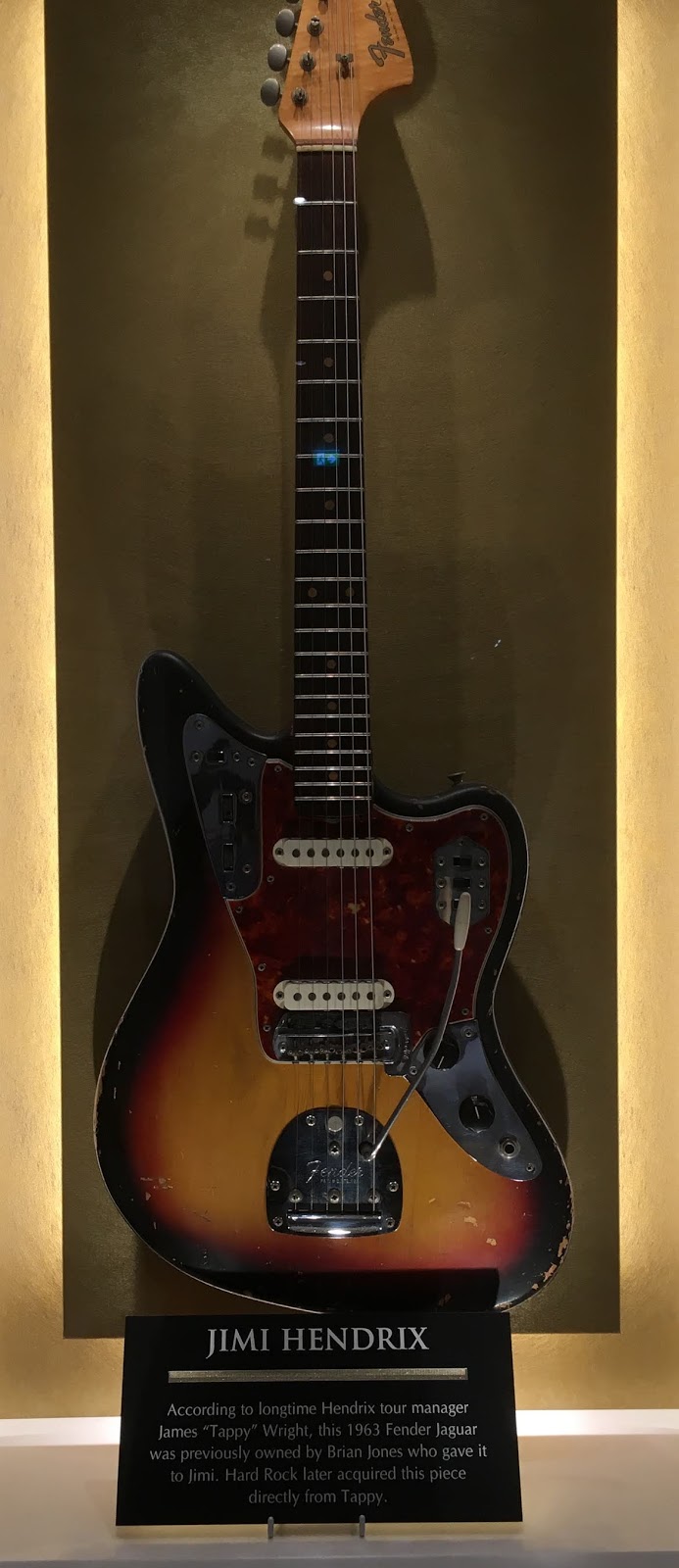
Formerly called the Cumberland, Jimi Hendrix had often stayed here and had a room on the fifth floor.  Other guests had included Buddy Holly and the Crickets, Bob Dylan, Stevie Wonder, Diana Ross, and Madonna.”  


Classic Rock played continuously in the background, and the walls were decorated with pictures of the Rock and Roll greats, their beautiful guitars in glass cases, and other memorabilia from the 60s and 70s which I had enjoyed in that coming-to-age period of my youth and which I still appreciate for its revolutionary innovation.


The hotel was diagonally across from the iconic Marble Arch on the northeast corner of Hyde Park, which we could see from the front door.


It is also famous for Speaker's Corner, where since 1872 anyone can stand on a "soapbox" and speak about anything.  Historic figures such as Karl Marx, Vladimir Lenin, and George Orwell were known to often use the area to demonstrate free speech, and the suffragettes also grew to prominence there.  One of our guides told us that the authorities gave the area a blind eye because, standing on a box, the speakers were technically not on British soil.

It was mid-morning by the time we checked in, and of course - what had we been thinking when we scheduled an overnight flight? - our rooms were not yet ready.  So we two jet-lagged travelers checked our bags with the Concierge and wandered down Oxford Street for an hour or so, marveling at the many cultures, the many languages, and the many wardrobes of this most cosmopolitan of cities.  Marks and Spencer and Selfridges were just a block or two away.

 
I had expected, but was surprised, to see so many men wearing turbans of one sort of another, and women wearing the traditional Hijab and Chador, and even the black Niqab with a mere one-inch slit for the eyes visible.  It is a bit of a culture shock to we residents of Highlands, where wealthy women parade down Main Street in Versace sunglasses and very expensive boots but do not wear such extremes of clothing.

Finally our room became available mid-afternoon, and almost immediately we stumbled in and took long afternoon naps, waking only slightly refreshed - our first day of jet-lag that would persist for two or three days.  Downstairs, we discovered that the Hard Rock hosted different bands every night, and a very good band was tuning up while we ate a light dinner, retiring to our room again before they began playing in earnest at 9:00 p.m.  Tomorrow promises to be a busy day.


In our room, I discovered that the mirror was engraved with the heights and names of various musicians who had stayed in the hotel, including Bob Dylan, Madonna, and Lady Gaga.  The shortest, ironically, was Ariana Grande (5'-0"); the tallest was Jay Z (6'-2"). 

Tuesday, August 13, 2019

Charlotte to London

To begin our journey to Britain and Ireland, we drove to Charlotte on this hot August afternoon, first south through Walhalla and kudzu-covered South Carolina and the bright blue waters of Lake Keowee, then westward into North Carolina, sticky with midsummer southern humidity.  We had been told by our British friend Brian, "Take an umbrella," but we really did not know what else to expect meteorologically.  We checked in at the Holiday Inn, which offers vehicle storage in a secure parking lot and is only a mile from the Charlotte Douglas International Airport and our direct flight to Heathrow.  We had been instructed by our travel agent to take everything in single suitcases, not to exceed fifty pounds, plus a small carry-on each.  This did not seem like enough luggage for a 23-day journey through Britain and Ireland!


All night we could hear the sounds of arrivals and departures.  A search on Google told me that the Charlotte airport is the fifth busiest in the nation, with 543,944 take-offs and landings each year; that works out to 1480 per day, or 62 per hour, one right after another!  It became ultimately a soothing kind of sound, and as we fell asleep, I imagined that I could tell the difference between departures, with their roar of acceleration and upward climbing and miraculous flight, and arrivals, the decelerating taper of landing on solid ground again.

To many Americans, travel by air is routine, as ordinary as commuting by bus or taxi or train.  But I have only flown twice in my life before, the first time 15 years ago when we flew to London for a week-long visit to England, and then in 2011 when we flew to Boston to run the marathon.  I am not afraid of air travel as some seem to be, but at the same time I am not accustomed to it.  I have visited the Wright Brothers National Memorial in Kitty Hawk and I understand the principles of flight.


Still, I continue to marvel in a childlike way at the sheer miracle of flight, of a 250-ton aircraft lifting magically and effortlessly into thin air.  Did Orville and Wilbur ever consider what their brave and primitive little craft, no more than a motorized kite after all, would eventually become?


Tuesday, August 6, 2019

Ready to Embark

It has been some time - May 20, in fact - since I mentioned in this blog that Martha and I are going to embark on a journey to Britain and Ireland to celebrate our 40th Anniversary.  Embark - isn't that a lovely word?  It comes from the French embarquer, which is in turn from the word barque, a small ship. 


Our small ship this time will be an American Airlines 333, which seen up close would appear to be a large ship.  But as seen from the perspective of its flight path across the wide Atlantic Ocean, it seems to me like a tiny little barque, winging its way high above the deep waters.  I know that air travel is the safest mode of transportation by far, but I confess that the idea of a transcontinental flight makes me a little apprehensive.  If anything goes wrong, after all, where would we land?


But there is every expectation that nothing will go wrong, and God willing we will depart Charlotte next Wednesday and land safely at London Heathrow next Thursday.  I have only flown twice before now, once 15 years ago when Martha, Katy, and I flew to London for one week, and once eight years ago when we flew to Boston for the Boston Marathon.  15 years ago nothing went wrong, and I remember that we entertained ourselves during the eight-hour flight watching movies we had not seen.  And sleeping.


During the last few weeks, we have been organizing ourselves for this wonderful 23-day journey which will begin next week - passports, travel clothes, compression socks, and all the many other things we will need.  The compression socks (along with aisle seats and frequent flexing of leg muscles) are intended to prevent Deep Vein Thrombosis, which we have read affects runners because of their higher red-blood-cell count.  I don't think we are leaving much to chance!  Our British friend and Boston Marathon veteran Brian immediately gave us advice we have heard from many quarters:  "Bring an umbrella!"

We will be taking a Trafalgar tour (the same company we used 15 years ago) which will take us from London to Scotland and Wales, then across to Ireland and back.  Some of the places we will see will be Stratford-Upon-Avon (Shakespeare's  birthplace), Edinburgh, St., Andrews, Glasgow, the Lake District, Liverpool, Dublin, Belfast, Galway, Limerick, Blarney, Waterford, Cardiff, Bath, Plymouth, ending with that iconic prehistoric monument on the Salisbury plane, Stonehenge, before returning to London.  Yes, we will kiss the Blarney Stone (and immediately clean our lips with hand sanitizer)!

As an English Major, I know many of these places through literature.  I wrote my senior thesis about Joyce's Ulysses, which famously takes place on a single day - June 16, 1904 - in Dublin.  I had the opportunity to take a trip to Dublin at the time with some of my professors, retracing the steps of its hero Leopold Bloom, but alas I was a poor scholarship student and could not afford to go.  So 50 years later I am looking forward to seeing that Dublin Castle immortalized in Finnegans Wake:  "riverrun, past Eve and Adam's, from swerve of shore to bend of bay, brings us by a commodius vicus of recirculation back to Howth Castle and Environs.”


And, of course, we will visit Shakespeare's birthplace in Stratford-Upon-Avon, as well. I think I know England through Shakespeare as much as anything; even when set in Denmark (Hamlet) and Verona (Romeo and Juliet), these plays somehow seem rooted in what Blake called "England's green and pleasant land."

This blog, then, will fall silent for a few weeks, but I will plan to catch it all up again, day by day, as I did when we traveled to California and back in our Mini Cooper in 2016.  On that trip, I took plenty of photos and made notes in a little journal each day which I referred to when we returned.  I spent some time last week in several shops in Highlands looking for an appropriate journal but came up empty-handed.  When I told this to Martha, she smiled and said, "I think I have one for you," and in no time, uncovered from some secret and magical storage space, this beautiful little journal:


What could be more appropriate than the famous woodblock print by Hokusai on the cover, "The Great Wave off Kanagawa," with its little barques struggling against the great wave of time and distance and fate, the sacred Mount Fuji appearing in the background.

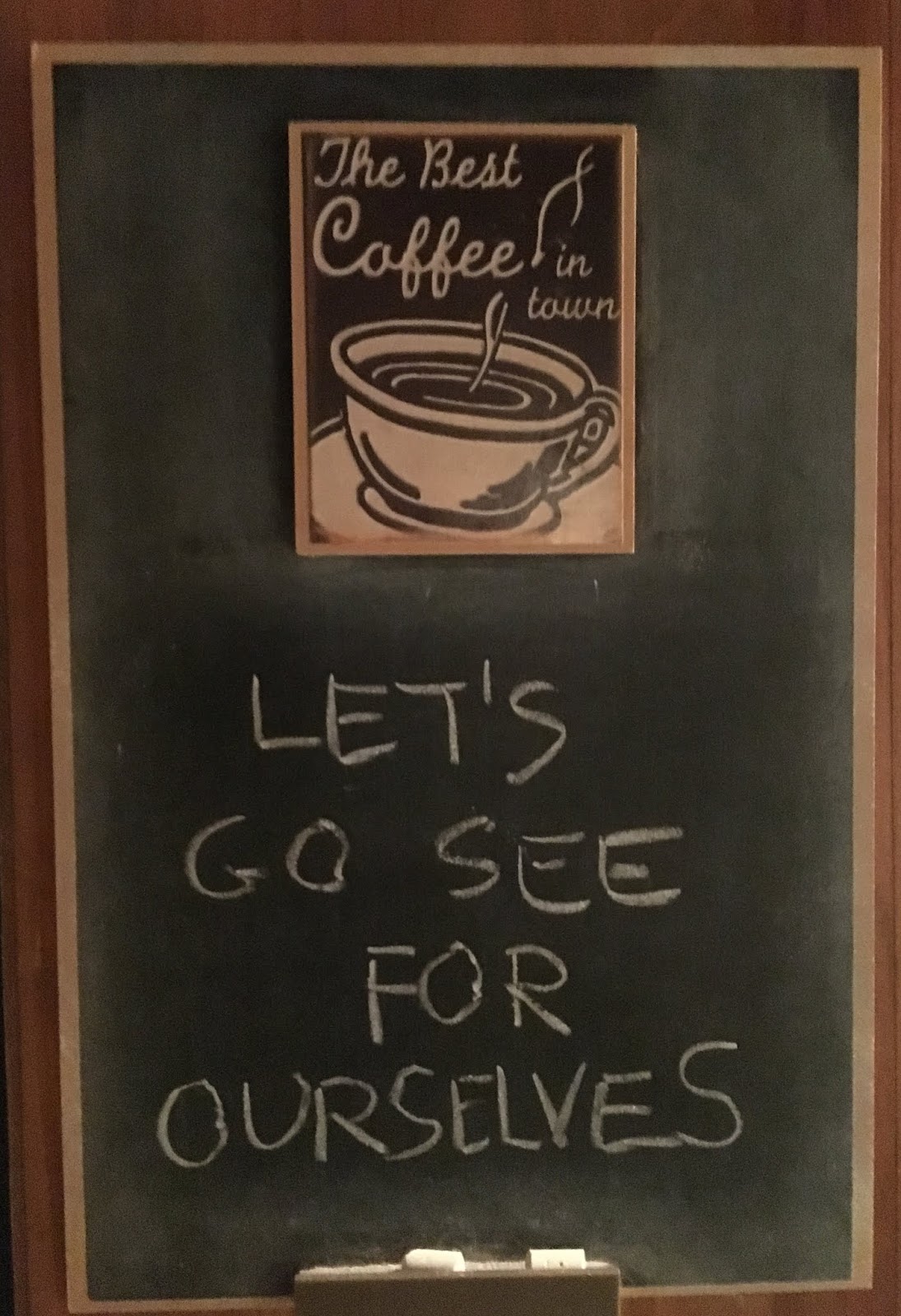
We are ready to embark.  And the little blackboard in our kitchen says this:


Saturday, August 3, 2019

80s Flashback 8-K

Martha had been looking around for another race to run before we leave on our trip to Britain, and only two or three days ago she found one nearby.  It is called the 80s Flashback 8-K and takes place on the Little Tennessee River Greenway in Franklin, a place where neither of us have run before.  


According to the race website, the race is the centerpiece of an 80s-themed weekend in Franklin, including a parade this morning and a party last night featuring a Cyndi Lauper look-alike.  Who is Cyndi Lauper, I found myself asking?  The name sounds familiar.  A Google search tells me that she sang the classic “Girls Just Want to Have Fun,” which I seem to dimly remember.  Martha and I must have missed the 80s – we moved to Highlands in 1983 and were immediately busy building a family, a home, and careers – but apparently there is some lingering nostalgia for Ms. Lauper on the part of race organizers.  “Take a trip back to the 80's for nothin' but a good time for a GREAT cause!” the website suggests.  The cause is the Shriners Hospital, to which 100% of the proceeds will be donated, and that sounded like a worthy one to us.


Martha convinced me that it might be fun to run five miles, a race distance we have not completed since 2015.  (Girls just like to have fun, after all.)   As far as our training plans, it made as much sense to run a five-mile race as to run an eight- or nine-mile long run as we normally do on Saturday morning.  This Saturday morning was a little different because we had attended a 10:00 a.m. funeral service for our long-time friend Christy Kelly, who died on July 31, and we have been thinking about her all day.  "I’m gong to dedicate this race to Christy,” Martha said.  And I readily agreed.

When we arrived at the Greenway, we discovered that the surface seemed to be rough gravel, and we came close to abandoning the race; running on a rough surface would not have been good for either of us just now.  But the Race Director assured us most of the Greenway was paved.  Thunder rumbled in the background, but the only rain that materialized was a light mist that was cool and refreshing.  For a Greenway along a river, though, the course was surprisingly hilly.  We both got off to a good start and were quickly glad that we had not abandoned.  We found ourselves out in beautiful meadows, and crossed the river several times on bridges.  What a beautiful course!


We compared notes later and found that we had both been thinking about Christy during the race, and it had been very empowering.  She had fought cancer for twelve years, going into remission several times, until finally succumbing this week.  A strong, kind, sometimes feisty woman with an indefatigable sense of humor, she never complained about having cancer.  So we did not complain either, climbing hill after hill.  We had signed up for this race, after all.  Christy had never signed up for cancer.

I realized when I crossed the finish line that the course had not been accurately marked; it was 5.10 miles, not 5.00.  So, adjusting for the difference, I completed it in what would have been a 1:00:49, and Martha in 50:09.  That was good enough for another First Place for her, and a surprising Third Place for me; I had merely wanted to finish strong.


It was a beautiful evening driving back to Highlands, mist rising in front of the mountains, the light refracted in some peculiar way as we climbed through the Cullasaja Gorge.  We were glad that we had used this day well, dedicating it to Christy Kelly, running strong all the way to the finish as Christy had done. 

Friday, August 2, 2019

Native Gardens

In yesterday's post, I wrote about interesting local events right here in Highlands that we have sometimes overlooked.  Today we attended another such event, consisting of a program at the Community Building in the morning and a garden tour in the afternoon.  The garden tour was of Jane and Tom Tracy's garden on Bowery Road, one which we were eager to see; they are both gracious people and avid gardeners, and we often see them working on the beautiful garden at the Episcopal Church in Highlands.

The morning program was about Invasive Plants and it was sponsored by the Coalition for Nonnative Invasive Plant Management, its acronym (CNIPM) providing the clever mnemonic "Snip 'Em."  The Highlands plateau is considered by ecologists world-wide to be a biodiversity hot spot, began Jim Costa, Executive Director of the Highlands Biological Station, but unfortunately it has also become a hot spot for invasive species:  witness the mighty hemlock trees in our surrounding forests felled in recent years by a tiny, almost invisible insect, the hemlock woolly adelgid.  I treat a huge hemlock ten-feet from the back door of our home every four years with an insecticide, which is the only way individual trees can be saved (and thus far it is working).  But the skeletal remains of hemlocks can be seen in places like Joyce Kilmer Memorial Forest, a change almost as significant as the Chestnut blight that killed four billion trees in the first half of the 20th century.

We already knew about kudzu - "The Vine that Ate the South" - and Japanese knotweed.  In fact, I  spearheaded a program fifteen years ago when I was Town Administrator to obtain funding for an eradication of the knotweed, but alas it has come back again due to a failure to keep up the program since then; some of these species take many years to eliminate.  What we did not know until recently was that several years ago we had unknowingly planted one of the shrubs on the invasive list, the burning bush (euonymus alatus), and had in fact planned to plant some more this year.  Burning bush turns a bright scarlet red in the autumn, grows abundantly in Town, and is still sold in nurseries to this day.  I may have written about this bush in these posts before because it is a harbinger of autumn.  Unfortunately, the little red berries are also carried everywhere by birds and can take over the understory of area forests (although we have seen no signs of that in our neighborhood).


The rest of the morning consisted of a presentation by Esther Stokes, a well-known landscaper from Atlanta, on what we should be planting in our gardens.  We have very few of these plants on our property at the moment, but now we have a comprehensive list, some good ideas, and the best of intentions.

When the program concluded, we drove to the Tracy's garden and had a box lunch that Martha had prepared, sitting in chairs on a perfect lawn overlooking the beautiful eight-acre grounds of their home.


We have toured gardens many times in the past few years both here in Highlands and more recently in Edenton, and we never fail to get some good ideas for our own modest little gardens.  What a difference, for example, some rockwork, flowerpots here and there, gates and fences, and other pieces of hardscape can make.


The Tracy’s garden looked natural, indeed, native Joe Pye weed nodding over rows of black-eyed Susans and daisies as if they had been planted there.  And there was such a profusion of flowers everywhere, both along the borders of the lawn and in the cutting and vegetable gardens.  Of course, one can do a lot more with eight acres in bright sunlight than in our humble single acre handicapped by tall shade trees all around.


In fact, I ended up taking far too many photos to post on this blog, soaking up one beautiful impression after another.
It was an afternoon to remember - but shouldn't every afternoon be one to remember? - wandering through the many flower beds, watching the lazy bumblebees and butterflies alighting, and learning about new plants and ways to beautify your property with them.