Wednesday, August 21, 2019

Loch Ness and Environs

I could have stayed a week or two at the Nethybridge Hotel, walking through the gardens where I went out to do my Tai Chi this morning, or curled up in a quiet corner of one of its living room. She was like an elegant older woman dressed in vintage clothing, still retaining her modest beauty.


It was another beautiful morning as we drove north on the A9 toward Inverness.  On the way, we stopped at the moving Culloden Battlefield, where the Jacobite forces of Bonnie Prince Charles were defeated.  It was a bloodbath, and Steve described it in blow-by-blow detail; they would have been sitting ducks in this open field.


It was a peaceful place this Wednesday morning, the sun brightly shining and a light breeze rippling the heather, which was growing everywhere.  There were even some hairy coos grazing in an adjoining field, and Martha took this picture.


We drove farther north toward Inverness, its beautiful castle on a hill as we drove through the city.  Canals connect three lochs (or "lakes") in this part of the country, some of the prettiest scenery we have seen.


By lunchtime, we were driving along Loch Ness, home of its famed "monster."  The area does cater  to tourists, and yes, we stumbled upon the monster herself outside a cafe and gift shop that was doing a brisk business.


There is even a Loch Ness Brewery, which makes a dark stout called DarkNess and a hop-filled IPA called HoppiNess - the label reads, "Vast and unfathomable, Loch Ness has long held its reputation as a dark, mysterious stretch of water, blessed with mythical healing powers, and home to the world's most famous monster - Nessie."  But the clever marketing was really unnecessary, because the lake itself was so beautiful, gleaming brightly between the surrounding hills.


We drove along the shore of the lake, Steve pointing out a simply stone monument to Roderick MacKenzie, famous for his brave but ultimately unsuccessful attempt to protect the life of Bonnie Prince Charles while he was fleeing and being hidden by sympathizers in one small village after another.  He strongly resembled the prince, and when he was spotted he ran away in feigned guilt, crying out, “Now you have killed your Prince!” before dying.

We stopped to take a photo of Eilean Donan Castle, on a small tidal island where three sea lochs meet, Loch Duich, Loch Long and Loch Alsh.  Steve told us it was one of the most-photographed castles in Scotland.


The weather had turned a little colder and there was a brisk breeze blowing from the water when we stopped on the east coast of the Isle of Skye.


Steve played us a CD of traditional Scottish songs, and we were surprised that many of those on the bus were singing along.  Do they sing these songs in Australia, or Canada, we wondered?

At the end of a long day, we stopped at the Gairloch Hotel, perched high above Gairloch Bay, with spectacular views of the North Sea.  Like the Nethybridge and the MacDonald Cardrona before it, I would gladly have stayed here for another day, another week . . . another month?


We walked down to a pebbly beach and there I picked up a smooth round rock still wet form the North Sea, and put it in my pocket to take home.


Tuesday, August 20, 2019

The Scottish Highlands

The fitness class I witnessed yesterday was taking place outside on the lawn this morning, with the instructor again calling out incomprehensible commands.  "Gorch Mattosh!  Royt!  Five, Six!"  I would have joined them except that all of the participants were women.  And I knew I could not keep up.

We are already on a first-name basis with most of the other travelers, and it has been fun getting to know some of them.  Martha has always been better with names than I am, and I keep whispering to her as we file onto the coach in the morning "Now is that Carol?  What is Anne's husband's name again?"

We left early (as we do every day - this trip is not for late-risers!), driving north on the M90, back through Edinburgh and across the Firth of Forth (which for some silly reason I have always enjoyed saying).  Steve pointed out an older triple bridge on our right crossing the Forth River and told us that it was the first cantilever bridge in the world, constructed in 1882 and now a UNESCO World Heritage Site.


The countryside here is sparsely populated and very beautiful, with rolling hills and plenty of wind turbines, solar farms, and reforestation projects underway, each tree staked and protected against (I suppose) grazing sheep, which are literally everywhere.  Scotland is in the forefront of those countries leading the way in renewable energy; last year, it powered 88% of Scottish households.


By lunchtime we had arrived in St. Andrews, home of one of the oldest centers of Christianity and also one of the oldest universities.  We walked down its medieval streets toward the sea, enjoying the salty tang.


We walked through the ruins of St. Andrews Cathedral, ca. 1318 and the most important medieval church in Scotland.  These ruined cathedrals have a special kind of dignity; walking down the open nave, gazing at the stone arches, we can imagine how awe-inspiring it was 600 years ago.

We also walked past the North Point CafĂ©, which William and Kate – the Duke and Duchess of Cambridge – frequented on their first dates, a sign in the window announcing, "Where Kate Met Wills." 


We passed more than one golf shop in St. Andrews because, of course, it is the home of the Royal and Ancient Golf Club of St. Andrews, the oldest and most prestigious golf club in the world and the “Home of Golf.”  Players – the wealthiest of players, I am sure – were teeing off as we watched.  In the distance you could see Swilcan bridge and its famous 18th hole.


We continued north from St. Andrews, and I realized that I was beginning to take on the vocabulary of the British.  "I'll meet you back in the car park," I would say, rather than parking lot.  A pull-off is a lay-by.  And of course, a lift is an elevator.  One of the Aussies, I realized, didn't know what I meant when I said the elevator was out of order.  The Aussies have their own peculiar expressions, too, of course:  "Good on ya," instead of "Good for you."  And I know I should be accustomed to driving on the left by now, but when I'm sitting toward the front of the coach and we are coming around a corner and see a truck approaching in the right lane, I am absolutely terrified for a moment or two.

We started to see more and more silver birches in this part of the country, reminiscent of white birches in Vermont, and also plenty of black-faced sheep, and those brown, shaggy-haired Highland cattle unique to Scotland called hairy coos.  Someone would spot one in a field and call out, “Hairy Coo!” but I was invariably too slow to take a photo.  But do not despair, O readers of this blog! – there are some very good photos that will appear in coming days.


Our afternoon stop was Blair Castle in Perthshire, built 750 years ago, and the ancestral home of Clan Murray.  It is a Georgian mansion, in the Scottish Baronial Style, on 145,000 acres, and we enjoyed the better part of the afternoon touring its rooms and grounds.


We had ample time to stroll through the peaceful walled Hercules Gardens, too, complete with an Oriental-style bridge and a white swan on a lake.


Here, too, was an anatomically correct statue of the Roman God himself, resting casually on his pedestal, as if fresh from one of his twelve labors, perhaps slaying the Nemean Lion.


We climbed higher and higher into the countryside, where there did not seem to be very many homes, let alone hotels large enough to accommodate 48 tired and hungry tourists.  So it was a surprise to suddenly stumble on the quaint Nethybridge Hotel, in the middle of nowhere, like something out of another era – creaking uneven floors, glorious fading tapestries on the walls of the dining room , and manicured garden paths.  I would have enjoyed staying in that tower room, too!


Monday, August 19, 2019

The Royal Edinburgh Military Tattoo

This morning I awoke and went downstairs at an unusually early hour - I think we are finally catching up with jet lag - in order to do my morning Tai Chi, and perhaps to work out in what I had learned yesterday was a nice fitness center at the Spa.  An exercise class was underway within, and a very fit young woman admitted me and returned to the class of nine or ten women being led by an equally-fit young man, who kept calling out instructions in a Scottish brogue completely incomprehensible to me.

I did some exercises with weights, and then went outside into chilly, windy, exhilarating conditions, intending to merely run around  the parking lot, but ended up completing one mile - my first run in Britain.  We found, as the trip progressed, that plans to run half a dozen times during the trip turned out to be as foolhardy as reading the small stack of New Yorker magazines I had brought with me -  there was simply not enough time or opportunity.

We boarded the Coach and made our way to Edinburgh, the capital of Scotland and its second largest city, with Castle Rock dominating the mountain in its center.


It's narrow streets were teeming with people here for the Edinburgh Tattoo, a spectacular evening show going on all month that had been included with our trip and which we had been told not to miss.  Also underway was the Edinburgh Festival Fringe, the largest arts festival in the world.  There were theatrical performances everywhere, including two satirical productions whose posters I spotted which were gleefully ridiculing American politics.


Travel director Steve not only explained the difference between Georgian, Romanesque, and Gothic architecture, he also dispensed sound advice along the way.  "If you happen to buy a kilt," he said, "Be certain that you buy an expensive one with lots of heavy pleats.  That way it won't blow in the wind!"  I had not intended to buy a kilt and did not change my mind.

The coach stopped for our "Local Specialist," Seana - "shawna," she pronounced it, and yes her Mum had named her after Sean Connery.   She took us on a tour through the city, including the Royal Mile, the Palace of Holyroodhouse, and the new Scottish Parliament building.  Please, Seana, I thought; keep talking!  We love your accent!  She pointed out the Edinburgh version of the Register of Deeds and said it was known as the Office of Hatches, Matches, and Dispatches.  She also showed us some graveyards containing stone watchtowers, constructed in order to prevent grave-robbers from disturbing  the dead.

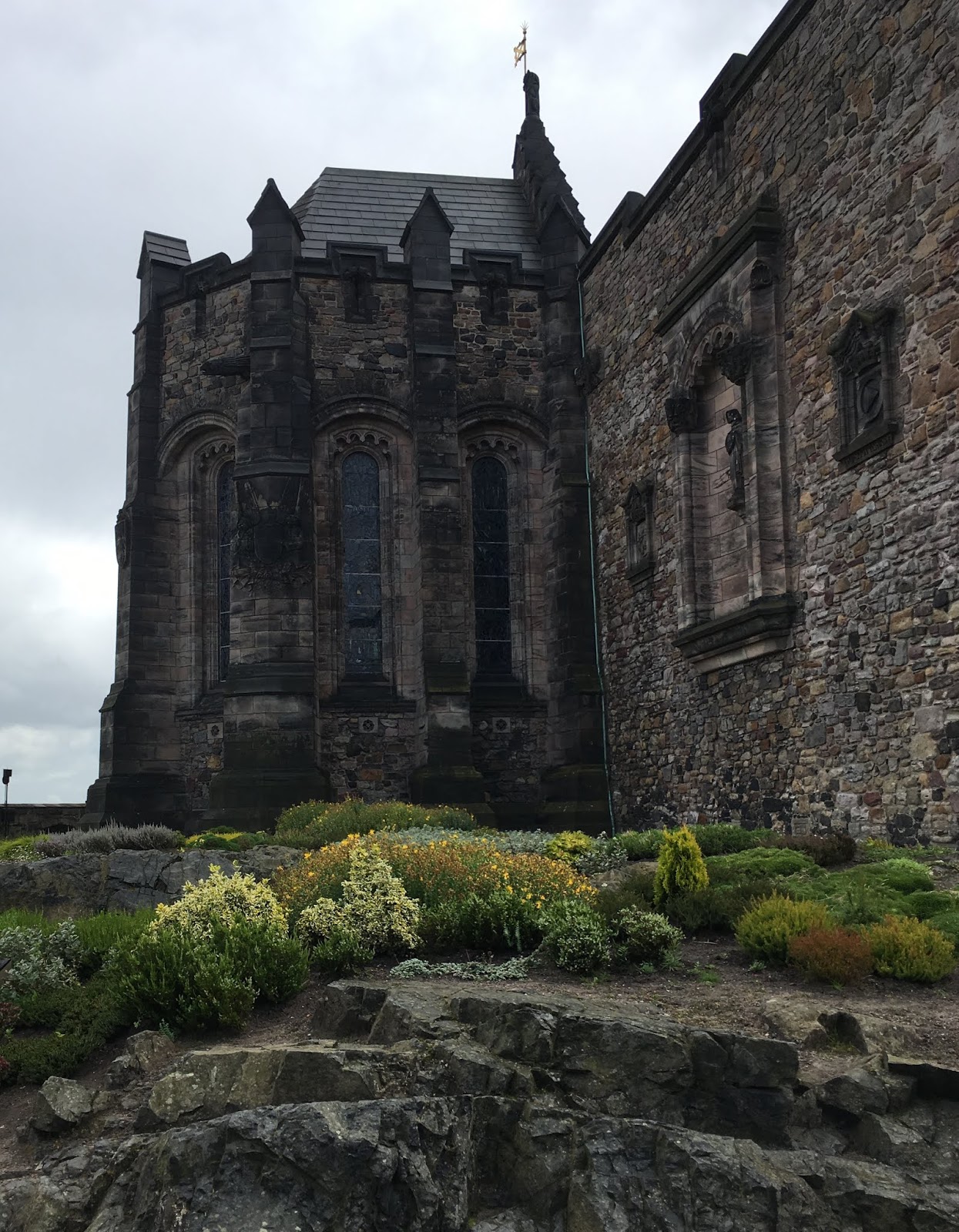
Seana escorted us to Edinburgh Castle, and in light rain we climbed to the very top of Castle Rock, actually an extinct volcano which had last erupted 350 years ago; we squeezed through the narrow passages of this impregnable fortress, fending off crowds of mostly German and Japanese tourists. 


After our tour of the Castle, we had some free time to explore before returning to Peebles and then coming back this evening for the Tattoo.  I noticed that there were several bars offering the single malt whiskey that Scotland is known for producing.


This bagpiper was playing for loose change just outside the Castle and was glad to pose for photographs. 


We had lunch upstairs in Deacon Brodie’s Tavern, ca. 1741, which was absolutely packed with visitors to Fringe and Tattoo - smoked haddock and kedgeree fish cakes, and delicious!  When we came outside onto the crowded street, there was an entertaining sword-swallower/juggler/comedian performing street theater.  The city seemed to be filled with such spontaneous productions, a simple hat passed around afterward.


After dinner, we returned for the Tattoo, which is a military-type performance featuring bagpipes and fifes and drums, not only from Scotland, but from other countries as well.  It seemed to resemble in some ways the Folkmoot Festivals we have in our part of the country.  It was absolutely spell-binding.

At the beginning of the Tattoo, the Master of Ceremonies called out, “Who’s here from Scotland?  Who’s here from Wales?  Who’s here from Canada?”  We few Americans applauded when they called out our country.  There were people from, it seemed, every corner of the world, enjoying this peaceful display of their military forces.


It was 12:30 a.m. before we finally returned to our hotel, way out in the darkness of the Scottish countryside.

Sunday, August 18, 2019

Edinburgh

Once again, the bright blue sky in Leeds this morning contradicted the conventional picture of a rainy England, its streets filled with open umbrellas.  We were on our way to Edinburgh today, and we stopped along the way in the city of Durham to see its magnificent cathedral.  We walked uphill on cobbled streets on this Sunday morning with its little shops and cafes just starting to open, the imposing cathedral towers visible at the end of the street.


On the way up the hill, we spotted these British phone booths, holdovers from another era and in immaculate condition.  They appeared to be operational even to this day, although - as in this country - everyone, including children in strollers, seems to have a mobile phone surgically attached to their hands and unusually large thumbs. 


We also spotted this unusual sign on a sidewalk outside a cafe that had just opened.  Since my face is still a little hairy, I did not enter, although I take it I would have been welcome,


We also passed this mere church, this "ordinary" structure, on the way to the magnificent structure protruding above the buildings before us.  It was St. Nicholas’s Church (Church of England), and in any city in this country would have been extraordinary. Here it was dwarfed by Durham Cathedral.


Although there are some exceptions, generally if a town or village in England has a cathedral it is known as a city.  In this case the cathedral was the Cathedral Church of Christ, Blessed Mary the Virgin, and St. Cuthbert or Durham, called more simply Durham Cathedral, ca. 1093.


Yes, ca. 1093.  I let that date sink in.  926 years ago.  This church had been standing on this spot for 527 years when the Pilgrims landed at Plymouth Rock.  I chatted with some of our other travelers as we marveled at the architecture, the engineering, and the construction techniques that went into building this beautiful 217-foot tall stone structure, when the tools were primitive and the rocks would have been hauled up this hill from area quarries in horse-drawn carts.  Long before the invention of steel, there was not a crack to be seen anywhere.


We tiptoed through the imposing door, removed our hats, and gazed in awe at the stained glass windows and carved stone columns.


I stood in the rear and listened to part of an interesting sermon being delivered by the Priest, touching upon  the current unrest surrounding Brexit - they apparently did not shy away from politics - and how important it was not to become spiritually unmoored by the uncertainty of the future.

We walked across the green and ate a light lunch in the Durham University Cafe, operated by friendly students - vegetarian paninis of caramelized onions, tomato, rocket, and roasted aubergine - that would have been welcome on an American lunch menu, except that I had to look up "rocket" (arugula) and "aubergines" (eggplant).

We stopped not far out of Durham to view another historical icon, a remnant of Hadrian's Wall.  The wall was begun by Romans in AD 122.  Now that is a date to consider; it makes a 1093 cathedral we had just seen seem like a modern building.


The road kept climbing higher and higher as we traveled north, and finally at the crest of the mountain we crossed into Scotland.


A few miles into Scotland, we stopped at the picturesque town of Jedburgh, famous for the ruins of Jedgurgh Abbey, a ruined Augustinian abbey from the 12th century.


I walked up to the top of the street past the ruins, and saw that Jedburgh was a pleasant little place, with cafes and pubs and little shops - the kind of village that I did not think existed anymore in Britain.  "I could live here!" I found myself saying, the first of many places on this trip that seemed to be especially habitable.  We made out way out of Town and passed another remarkable sight - an ancient oak tree known as the Capon Tree, thought to be between 500 and 1000 years old. 

We also had our first view of heather, the legendary flower of Scotland, which blooms only twice a year and peaks in color (another traveler told me) for only ten days.  Already its purple flowers were beginning to fade into brown.

Our travel director had given us ample time to explore on our stops, and he was also good at strategically-placed snack and bathroom breaks.  We stopped at a seldom-frequented little cafe along the way for that purpose, and the grateful owner gave Steve a box of fresh shortbread, enough for him to share with the whole coach and our first genuine taste of this melt-in-your-mouth Scottish confection.

Finally, at the end of a long day, we crossed the River Tweed - one of the great salmon rivers of Scotland and also, we were told, the origin of that woollen cloth's name - and pulled up in front of the MacDonald Cardrona Hotel Golf And Spa in Peebles, our home for two nights and of all the places where we stayed on this trip perhaps my favorite.  There was a lovely golf course, mountain bike and hiking trails, and stunning views all around.


Some of our fellow travelers had signed up for a dinner and show in Edinburgh, but we had opted for some light food in an almost-deserted downstairs dining room, looking out the window on the golf course.  


Our young waitress had a lovely Scottish accent, and we tried to keep her in conversation as long as possible just to listen.  Martha had noticed that many of the golfers seemed to be walking the course instead of using golf carts and she asked her about that.  "It takes about five hours," she said.  "Most of them walk and come back crying."