Wednesday, September 4, 2019

Plymouth Harbor and St. Michael's Mount

Our tour included a cruise in Plymouth Harbor.  On the way to the Harbor, we passed the Royal Citadel, perched on high rocks above the harbor, built in the late 1660s; it encompasses the site of the earlier fort that had been built here in the time of Sir Francis Drake, he of the cool head and determination to complete his game of bowls (see previous post).


Nearby were the famous Mayflower Steps, where passengers had supposedly departed Plymouth in 1620, nearly 400 years ago, on their 66-day voyage to Cape Cod.  Other famous ocean voyages had begun here, including Charles Darwin on the HMS Beagle in 1841.


As we cruised down the harbor, we saw many military ships, and also the conning towers of several decommissioned submarines; we were told that the submarines had to remain where they were for 30 years until their nuclear reactors had cooled.

 
Karl was awaiting us in the coach at the end of the ferry cruise, and we set forth into beautiful Cornwall again.  Steve explained that Cornwall was unique because it contained many unusual minerals as a result of the weathering of the felsic intrusions (our Steve was a knowledgeable geologist as well as a historian) - felsic rocks are igneous rocks rich in elements like uranium, zinc, copper, antimony, and arsenic.  Kaolin was also deposited in massive amounts here, and we passed the world's largest clay pits; the clay is still mined and is used for fine porcelains by Lenox and Wexford.

Of special interest were the presence of copper and tin, which together can be alloyed into bronze; because of this, the area became, as early as 1500 BC, a place where the Bronze Age began in England - that crucial link between the Stone (or neolithic) Age and the Iron Age.  The presence of tin may have been what, legend has it, brought the merchant Joseph of Arimathea, uncle of Jesus, to England.  It is an interesting legend and purports to account for those missing years in Jesus's life in the Gospels by saying that Jesus as a young boy traveled to England.  That legend, completely unsubstantiated, has been alive for 2000 years.  Further legend believes that Joseph of Arimathea returned after the death of Jesus and started the first “cristen” church of England in the village of Glastonbury around  60 AD.  The myth purports that Joseph decided upon Glastonbury because when he put his staff into the ground on Wearyall Hill, it took root and flowered.  The legend is the basis for William Blake's poem Jerusalem, the unofficial "anthem" of England."

And did those feet in ancient time
Walk upon England's mountain green?
And was the holy Lamb of God
On England's pleasant pastures seen?
And did the countenance divine
Shine forth upon our clouded hills?
And was Jerusalem builded here
Among those dark satanic mills?

This part of England is so beautiful that it is easy to believe that it has been touched by divine feet.


Here, too - in contrast to those "dark satanic mills" - we saw signs of a more progressive and enlightened England (which we also saw in other parts of the UK and in Ireland), miles and miles of wind turbines and solar panels:  clean energy (alongside Belted Galloways).


We continued along the coast to the seaside town of St. Ives, an artist's colony because, according to Steve, artists began coming here from London and discovered that the light was very special.  The Town is a popular resort, notably achieving the title of Best UK Seaside Town from the British Travel Awards; it is filled with galleries and shops and restaurants, and we spent some time wandering through its narrow, winding streets down to the ocean.


St. Ives is also known for its “pasties” – meat-filled pies that we first encountered in Michigan in 2016, coincidentally enough; the pies arrived in Michigan's Upper Peninsula in the 1840s, brought there by Cornish miners who immigrated to that part of the country.  Three years later, we were in the "Mother Country" of pasties.


We had had a filling lunch at a cafe in St. Ives, and had spoken to a friendly server.  We told her that we were going to be visiting Stonehenge, and she told us that when she was a little girl, her family would visit the site; it was deserted most of the time, and they would sit on the rocks and eat a sandwich.  

We did not opt for pasties today (although we had eaten them in Michigan).  But when we arrived at the beach itself and the usual seaside eateries there, Martha decided that the occasion called for an ice cream cone.


It was a warm and sunny day, and visitors were sitting on benches soaking up the last warm sunny days of September, eating fish and chips and pasties; some were wandering down to the water, taking off their shoes, and dipping their toes in the cool water.


We continued on from St. Ives to St. Michael's Mount.  Monks from Mont St. Michel in France established a priory here in the 12th Century on an unbridged tidal island like the one in France.  I collected another rock there - my third on this trip - a small round pebble; I am holding it in my hand as I write this blog and remember that warm, sunny day on the English coast.


We returned eventually to Plymouth again and enjoyed our "Farewell Dinner" at a restaurant called The Mission.  Their website describes it well:  "This 19th century Thomas Mission Hall, with its high ceilings and aromatic smells from the kitchen, is the perfect place to settle for a flavoursome, satisfying, and well accomplished British cuisine.  Our selection of menus cater handsomely to diners on the go, romantic meals for two, friends, and family gatherings."  I suppose we fell into the "friends" category, because at this point in our journey we had become friends with so many of our fellow travelers.  It was a good evening!


Tuesday, September 3, 2019

Bath and Cornwall

This morning we left Cardiff and crossed the Bristol Channel and River Severn back into England.  The funnel-shaped channel and estuary combine to create what is called a tidal bore - the Severn Bore - forcing water upstream as far as Gloucester.  Steve told us that there was a 40-foot difference between low and high tide, and he had heard that surfers can actually surf upriver.

We arrived in Bath, one of the few places we had visited before in England on our trip 15 years ago.  It is a popular destination, and deservedly so, with its perfectly preserved 18th Century Georgian architecture and buildings constructed of honey-colored limestone.


The narrow stone-paved streets are everywhere, pedestrian-friendly and inviting exploration.  It was an overcast day and we enjoyed exploring an area still familiar in our memory.  It reminded me of Prospero asking Miranda in The Tempest (which I have been re-reading),

But now is it
That this lives in my mind?  What seest thou else
In the dark backward and abysm of time?


The hot springs feeding the Baths were “discovered” in AD 60-70 by the Romans, but it was believed that Celts worshiped here earlier; the water is a soothing 46 °C (114.8 °F).


The site was re-designed in the 18th century, which was the date of all of the Georgian buildings now standing on the site.


The water is no longer used for bathing, and visitors were cautioned not to touch it; a dangerous type of amoeba was discovered here several years ago.  We needed no caution - the water did not look inviting.  The same hot water can be enjoyed in other places nearby.  

There was a beautiful bust of Minerva, Roman goddess of wisdom (and also, parenthetically, strategic warfare).


And there were other lovely statues dating from the 18th century as well.  

The especially fine Bath Abbey stood diagonally across the street from the baths, a Church of England parish that had the long history of so many of these places of worship - founded in the 7th century, reorganised in the 10th century, and rebuilt in the 12th and 16th centuries.


From somewhere in "the dark backward and abysm of time," we remembered eating a pub lunch in Bath 15 years ago at a place called The Crystal Palace, and after all of this time it was still there.  The young lady who brought us our lunch enjoyed that story, although she would have been a toddler at the time.


From Bath we journeyed to Plymouth to the southwest, through flat land along the Bristol Channel at first where hay was being harvested, hay bales in other fields waiting to be gathered in.


And then we were climbing through hilly country, the lower extent of the Cotswolds.  As we approached Plymouth, Steve gave us a highly-detailed description of the defeat of the Spanish Armada in 1588.  English ships sailed from Plymouth to decimate the fleet of 130 Spanish ships, but not before the famous game of "bowls" or lawn bowling by Sir Francis Drake could be completed.  The game, dating to the 13th century, was hugely popular in 1588, and legend has it that when the Armada was sighted in the channel, Drake coolly insisted on finishing his game (which incidentally, he lost) before taking on and defeating the mighty fleet.  Some scholars think it had more to do with waiting for the tide, but I like to think the legend is true.

We passed the ruins of Charles Church in Plymouth, which was bombed during World War II; it has been left in ruins as a memorial to those killed during air raids on the city, and perhaps as a sober warning of the terrible destruction wrought by warfare everywhere.


After arriving in Plymouth, we crossed the River Tamar to Cornwall by means of something I had never encountered before, a chain ferry.  The Torpoint Ferry has been in service since 1791; three separate ferries, side by side, operate by pulling themselves on heavy chains across the river - taut chains in front, slack chains behind which sink to the bottom to allow shipping movement in the river.  

Cornwall had some of the prettiest countryside we had driven through, rolling hills between green fields where cattle were grazing.


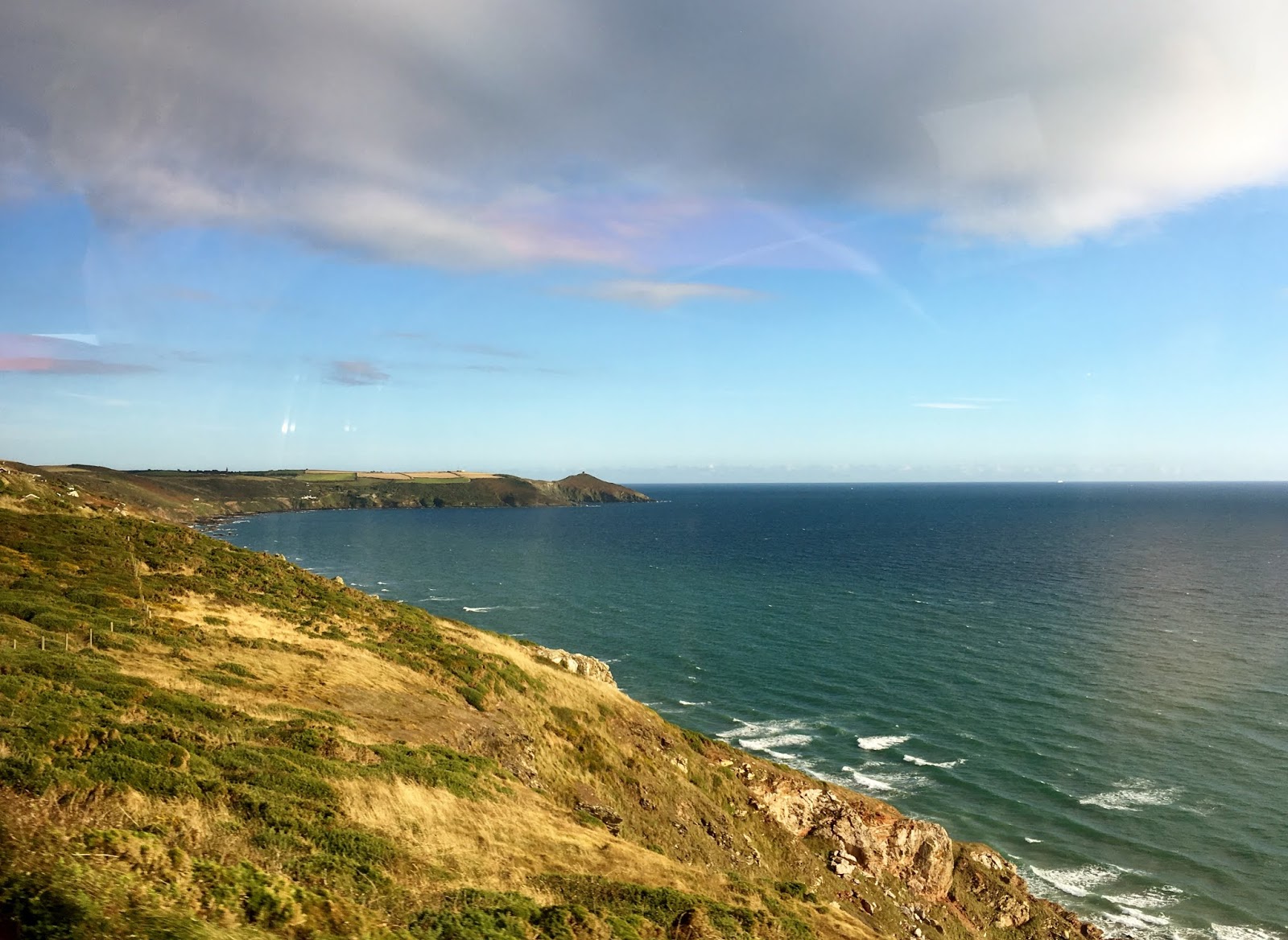
As we approached the Cornish coastline, the road narrowed, looking down precipitous slopes to the water below.  On the far horizon we could see a tiny shape, a ferry crossing the English Channel to France 80 miles away.


At one point, we came around a curve and unexpectedly encountered a coach traveling in the opposite direction.  After an amicable pause while the drivers seemed to communicate in some unknown way, our driver Karl slowly began creeping in reverse along the road; a mistake of a foot on the right would have meant tumbling a long way into cold waters.  We breathed a sigh of relief as the other coach passed and Karl received a round of applause for some of the best driving we had seen on this trip.


Some of the little towns tucked in the coves below us resembled the fictional Portwenn in the BBC program Doc Martin (the series is actually filmed in Port Isaac some 50 miles away).


I could almost picture the irritable Doc marching down the steep street on his way to an emergency, surgical bag in hand, while shooing away a friendly dog.

At last we arrived at sea level, and it turned out we were in Cremyll, just across the River Tamar from Plymouth; we had taken a long, circuitous, and very scenic route to The Edgcumbe Arms, a historic pub in one of the prettiest settings in England.


After a hearty dinner, we all stood outside soaking up the tranquility.  Stalwart Karl had returned to Plymouth by the same route he had taken to get here, while we waited for a ferry – not a chain ferry this time, but a small vessel approaching in the gathering dusk - to take us back across the river to our hotel for the night.


Monday, September 2, 2019

Cardiff Castle

We set the alarm for 4:30 a.m. this morning and left the Fitzwilton Hotel at 7:00 a.m., early morning sunshine just starting to brighten the Waterford riverfront.  It was an hour drive to Rosslare Harbour, where we were scheduled to catch the early ferry back across the St. George's Channel to Cardiff, Wales.  On our drive to the ferry, Steve played us a CD of Irish music by a young man named Dan O'Sullivan.  We thought that, with its fiddle and a surprising banjo, it sounded a lot like Bluegrass music.

Hay bales were stacked in the fields, waiting for harvest.  We have watched summer turn into fall on this trip.


The ferry was smaller than the Ulysses that had taken us here over a week ago, and it was a rougher passage.  I opted for the smoked salmon wrap for lunch . . . instead of the James Joyce burger.

It took over four hours to reach Wales, and the rest of the afternoon in Cardiff we spent touring Cardiff Castle, a medieval castle and Victorian Gothic revival mansion located in the city center.  The original castle was built in the late 11th century by Norman invaders on top of a 3rd-century Roman Fort.  But in the 18th century, the 3rd Marquess of Bute transformed the castle, using his vast wealth to back an extensive program of renovations under the supervision of architect Willliam Burges.  Burges remodeled the castle in a Gothic revival style, lavishing plenty of money and attention on the place.  The interior is considered, according to Wikipedia, to be "among the most magnificent that the Gothic revival ever achieved."


Our tour referred to it as "Bizarre Cardiff Castle," and it was a good description.  From the outside it was not unlike other castles that we had seen, like Blarney Castle the previous day. 


But the inside was filled with fantastic paintings, carvings, tapestries, Islamic art, and gold gilt everywhere.  Hand-painted scenes from Hans Christian Anderson's fairy tales and Aesop's Fables adorned the nursery and other rooms.


I don't think we have anything comparable in this country except perhaps the Hearst Mansion or the Biltmore House.  It is hard to imagine this vast amount of money going toward such architectural and artistic beauty these days.

We climbed up the keep, or tower, at the other end of the fortification, and took in the view of Cardiff, spread out all around us.


Perhaps the most interesting part of the castle were these walls, buried for centuries and unearthed in 1922, adjacent to the gift shop.


On the way to our lodging for the night, the Park Inn in City Centre, we passed this shop selling Brains - that is, brews from Cardiff's regional brewery founded in 1882 by Samuel Arthur Brain.  

Sunday, September 1, 2019

Blarney Castle

I have to confess that I was not feeling very well this morning.  Whether it was something I had eaten on the hotel buffet last night or something else, I do not know - I will spare readers the details.  But by morning I was feeling better as we left Killarney and drove to Blarney Castle in Cork, through undulating hills and more beautiful countryside.  We passed more abandoned stone buildings, which in our part of the the South would succumb to kudzu and disappear completely in a few years, but in Ireland stand in stone and slate forever.


Blarney Castle and its beautifully landscaped grounds were a welcome stop.  I spent some time walking through its gardens, many of which featured subtropical plants (see previous post about the effects of the Gulf Stream).


I was still not feeling up to par, so I was glad to find a place to sit and have a cup of tea in a sunny courtyard with umbrella-covered outdoor tables, while Martha explored the castle itself.  I heard later that most of our group did not attempt to negotiate the narrow stairs with low ceilings, which would have proven difficult for a man of my height to negotiate.


The castle is remarkable photogenic, and I took dozens of photos from dozens of angles.  Built on earlier fortifications, as is often the case over here, the current "keep" or tower dates from 1446.  These early dates continue to amaze me! - that would be, after all,  half a century prior to Columbus "sailing the ocean blue."


The opportunity to kiss the famous Blarney Stone, a block of limestone built into the battlements of the castle, attracts visitors world-wide.  Wikipedia describes it this way:

 The ritual of kissing the Blarney Stone, according to the castle's proprietors, has been performed by "millions of people", including "world statesmen, literary giants, and legends of the silver screen.  The kiss, however, is not casually achieved.  To touch the stone with one's lips, the participant must ascend to the castle's peak, then lean over backwards on the parapet's edge.  This is traditionally achieved with the help of an assistant.  Although the parapet is now fitted with wrought-iron guide rails and protective crossbars, the ritual can still trigger attacks of acrophobia.

Brave Martha made her way up to the 127 narrow steps to the Blarney Stone and accomplished what was "not casually achieved," touching it, she said (cautious about the unsanitary idea of kissing a stone which had been kissed by the lips of  "millions of people) with her nose - an Eskimo Kiss!  And then she quickly applied hand sanitizer.


According to legend, she has now been endowed with the "gift of the gab."  As we climbed into the coach after the visit, I asked Steve how many times he had kissed the Stone.  His eloquence knows no bounds.

Our next stop was a sobering reminder of the Potato Famine of 1845, which Steve had already told us about.  Also known as the Great Hunger, it was caused by a fungus-like organism which spread rapidly throughout all of Ireland, ruining up to one-half of the potato crop that year, and about three-quarters of the crop over the next seven years. The potato was the main source of food for the ordinary tenant farmer.   The number of dead from starvation reached such calamitous numbers that local cemeteries filled up and mass Famine Graves were opened up, where large populations were buried; records are sparse, and it is not known how many thousands were buried in a hundred different graveyards throughout Ireland.    


We filed reverently from the coach to the gated entrance of the Famine Graveyard in Dungarven, on a hill in an open field; we could hear the busy traffic below us on the N25.


This poignant statue said it all, standing on the edge of the field, reflecting the desperation of starvation.


It was only a short distance from Dungarven to Waterford, home of Waterford Crystal, known throughout the world and dating back to 1783.


Although much Waterford Crystal is made outside of Ireland today, the House of Waterford Crystal is worth seeing, and Martha decided to take a local tour.  Master craftsmen were at work and she told me later that she could feel the heat of the furnaces used in creating these world class crystal pieces.   She also saw a miniature of the huge Time Square Crystal Ball created by Waterford Crystal, as well as a replica of a 911 creation presented to America in remembrance.  Then she went on a walking tour of Waterford, founded over 1100 years ago by Viking Warlords.  She saw the longest wood sculpture in the world, "Dragon Slayer," with intricate carvings that tell the story of the Vikings.  Waterford is also home for Reginald's Tower, the oldest civic building, dating back to 947 AD.


I decided not to go on the tour, instead walking along the River Suir through Waterford's pleasant streets to our hotel, the Fitzwilton.