Sunday, March 7, 2021

Painted Rocks and Paper Cranes

It turned much colder overnight, 34 degrees out on the dune-top deck this morning, where I did my Tai Chi to the accompaniment of that ebullient mockingbird that has taken up residence somewhere nearby.  I checked the forecast for the week and it looked absolutely wonderful.  

It being a perfect, cloudless sunny day, we decided again to drive to Fort Macon and hike the entire 3.3-mile loop of the Elliott Coues Nature Trail.  The parking lot was full and there were more people out on the trail than we have ever seen before, all of them having made the same decision we had.  Martha spotted this rock adjacent to the path that runs along the salt marshes, just on the other side of a wooden walkway.

She knew something about painted rocks but I did not.  I did some research and learned that they are a kind of nationwide scavenger hunt meant to promote positivity and kindness.  Smooth rocks of different sizes are painted, sometimes with faces or looking like ladybugs, often with inspirational words written on them.  Local communities are often involved, and there is a presence on social media.  There is an “NC Painted Rocks” Facebook page, for example.  What do you do when you find a painted rock?  If it is a small one, you can put it in your pocket and take it home.  This rock was about eight inches wide and would not have been easy to carry along this path, at least a half-mile in either direction.  So I left it where it was, wondering what the abstract picture was meant to represent.

When we returned to the condo, I set to work on a new skill that I have stumbled into – making paper origami cranes.  I can’t remember exactly where I first read about paper cranes recently, but the idea stuck in my head.  I learned there is an ancient Japanese legend that promises that anyone who folds a thousand origami cranes (千羽鶴, senbazuru; literally “1000 cranes”) will be granted a wish by the gods.  The legend was popularized in a book called Sadako and the Thousand Paper Cranes, the story of a Japanese girl who was two years old when she was exposed to radiation from the atomic bombing of Hiroshima during World War II.  The girl soon developed leukemia at the age of 12 and began making origami cranes with the goal of making one thousand.  Tragically, it is said that she folded only 644 before she became too weak to fold any more, and died in 1955.

I have been writing some poetry on our Sabbatical, and one of them is about paper cranes, and begins like this:

 I made a thousand paper cranes
From the silence within me,
And released them one by one. 

Since I was already so deeply invested in paper cranes, I decided I should learn to make one, which was more difficult than it looked.  After referring to a You Tube video several times, I was finally able to memorize the steps, folding and refolding, and folding again.

It was a little like memorizing a new piece of music, something I am also doing these days, the steps finally committed to memory.  I remember my piano-teacher Dad telling me, Practice Makes Perfect.  I practiced enough that I can make a paper crane out of any piece of square paper.  But in the process, I went through several sheets of print paper.

Friday, March 5, 2021

March is the Month of Expectation

It was my turn to write on the blackboard, so I posted the first line of Emily’s Dickinson’s poem:

March is the Month of Expectation.
The things we do not know—
The Persons of prognostication
Are coming now—
We try to show becoming firmness—
But pompous Joy
Betrays us, as his first Betrothal
Betrays a Boy.

It’s true, as Emily says, that there are the things we do not know.  But we can still expect that this month, and this summer, promises to be better than last year, for many reasons.

First and foremost, it appears that the coronavirus pandemic may soon be under control.  Our new President announced this week that he expected all American adults could be vaccinated by the end of May.  When we first arrived here in mid-November, I posted this in my blog:


The latest graph is much more optimistic, showing a dramatic decline.

The roll-out of the vaccine continues to be very impressive.  More than 82 million doses have been administered, reaching 16.3% of the total U.S. population.  We are now administering over 2 million shots a day.  Martha and I will be getting our second shot exactly a week from now, and along with many of our friends will be thankful to receive it.  Among the many conspiracy theories circulating on the internet is the notion that the vaccine is injecting a microchip in our bodies, courtesy of Bill Gates.  But I subscribe to Science, not to microchips and space lasers and lizard people.  And even if that were the case, I am guessing the chip would crash or need to be updated before long.

More good news:  the Covid Relief Bill which has been passed by the House and will soon by passed by the Senate has a wide range of features that will help those who are suffering – and suffering so much more than we are – including stimulus checks, aid for small businesses, extension of unemployment benefits, and more funding for vaccines.

Just this morning I learned of more good news.  Face masks, hand cleaning, and social distancing intended to combat Covid has also helped dramatically reduce influenza this winter. 

A single pediatric death!  That is nothing short of miraculous.

We will be returning to Highlands in only two or three weeks, and have enjoyed our Sabbatical in Atlantic Beach, where we have avoided the worst of the winter weather and been able to run, hike, and be out of doors most days.  As in past years, we hope to carry forward into the coming year the good habits we cultivated here – reading more, writing, eating healthy, and finding balance in our lives.  I cannot say often enough:  It is so generous of Martha’s Aunt Lizette to let us stay here!  From newspaper reports, it appears that some of our favorite events will resume in Highlands when we return, including the re-scheduled Twilight 5-K in May, the Highlands Motoring Festival, weekly Farmer’s Market, Craft Show, and summer concert series.  Face masks and social distancing will still be in effect, no doubt, but it will be a step toward some kind of “normalcy” once again.

It is March now and we are experiencing that typical see-saw weather that we also see in Highlands, one day dawning warm and sunny, and then winter returning the next day.  Yesterday was one of the former, and I was able to complete a six-mile run to Fort Macon, the first time I have done that in a couple of weeks, and dressed in my lightest running clothes.  By this morning the temperature had fallen and the north wind had risen.  For some reason, I awoke at 5:30, and found myself out on the dune-top deck with a cup of coffee an hour later to watch another  beautiful sunrise.

It was warm enough on our balcony this afternoon, in full sunlight and sheltered from the north wind, to eat lunch.  I had gone out earlier and found that our mockingbird, which returned a few weeks ago, was in full song, going through his entire repertoire again and again.  He kept moving from rooftop to rooftop, as if he were testing the acoustics in a concert hall.  For readers of this blog who can play a video I recorded this.

What a musician!  He is the very embodiment of Emily Dickinson’s “pompous joy!”

Saturday, February 27, 2021

Flattering Weather

The weather has warmed up now, and there are signs of spring everywhere – daffodils and pansies blooming, the grass turning greener.  I find strength when running in the cold and the wind by remembering that passage in As You Like It that I like to quote:

Here feel we not the penalty of Adam,
The seasons' difference, as the icy fang
And churlish chiding of the winter’s wind,
Which, when it bites and blows upon my body,
Even till I shrink with cold, I smile and say,
“This is no flattery. These are counselors
That feelingly persuade me what I am.”
Sweet are the uses of adversity. . .

On these suddenly warm mornings, it is nice to be relieved of the need to smile at the counselors of rough weather and instead to be flattered a little for a change!

This morning, I completed a comfortable four-mile run in a short-sleeved T-shirt, down to the Picnic Area, and then back and forth through the aisles of the parking lot to make up the extra distance.  It was a busy place, with runners and hikers coming and going, and several young bare-chested men dressing into wetsuits, preparing to go surfing.  They reminded me of runners showing up at the Park on a Saturday morning, the easy camaraderie and the chatter about surf and weather conditions that I could overhear.

After lunch, we went down on the beach where there was a lot of beach nourishment work going on.  A pair of boats were out on the water in front of us, one behind and one in front, moving a long section of pipeline floating on big yellow steel floats.  


When in the right location, the pipeline is maneuvered perpendicular to the beach and pushed as far onto it as it will go, where forklifts with curved forks grab them and drag them into position on the beach, then push and pull them to the end of the pipeline.  We could see the dredged material mushrooming into the air ahead of us, just past the Oceanana Pier, which was where this section of pipeline was destined. 

There were a lot of people out on the beach and they were all watching with fascination, as onlookers do in a city where there is a high-rise construction job going on.  A four-wheeler was patrolling the area and keeping the curious at a safe distance.  I took this video of the two vehicles at work, watching them swivel swiftly around in a fascinating ballet of graceful motion, a lovely pas de deux of forklifts.
 

We exited the beach on an access ramp near the Oceanana Pier and walked back on the half-mile road where I often run in cold and windy conditions because the north wind is blocked by a row of houses.  It was nice to stroll on this road at a slower pace, appreciating some of the nice architectural details of these oceanfront beach houses.  We have some upcoming projects in mind on our own house in Highlands this summer, and this is a good way to get some ideas.

Now, at 5:00 on a Saturday afternoon, it is 64 degrees, warm enough, perhaps, to go down on the dune-top deck and watch another gorgeous sunset.

Tuesday, February 23, 2021

72

The rule for birthdays in our household, and one to which I have willingly subscribed over the years, is that the birthday celebrant can do whatever he or she wants on that day. Some years I have felt that this was a burden, as Martha would ask me in the days leading up to the date, “What do you want to do on your birthday?”  And I would not always be able to decide.  That was not a problem this morning, with clear blue skies and warm temperatures.  Highlands Roadrunner went running – what else? 

I had run two difficult miles yesterday in strong wind and cold temperatures.  But the weather has changed, and this morning it was balmy in comparison, so I decided to run toward Fort Macon and try some “Picnic Area Intervals,” which I have not done since February 4.  Since we have arrived, I have struggled to break the one-minute barrier.  In my last session, for example, my times were 1:07, 1:05, 1:03, and 1:01.  I have hit that 1:01 split many times!  This morning, in defiance of my new age, I pushed those splits down to 1:02, 1:01, 0:58, and 0:58.  I think only runners can fully appreciate what a difference it makes to run just three seconds faster in a workout.

I went out onto the beach from the Picnic Area and ran back along the ocean,where Martha was walking and where she took this photo.  


“What do you want to do now?” Martha asked, and I wondered out loud if I had time to wash my running clothes before lunch.  “It’s your birthday,” Martha said with a twinkle in her eye.  “You can stay here and wash your clothes if you want to."  I decided to leave my clothes until later, and we left the condo for a picnic lunch at the same Picnic Area where I had run this morning.  Then we drove to Harker’s Island to the Core Sound Waterfowl Museum and Heritage Center, which I have mentioned before in this blog; I think this has been our fourth visit this year.  We had picked up a brochure about the self-guided trails on our last visit, and that’s what we did this afternoon. 

The Willow Pond loop took us through a maritime forest (live oaks, cedars) around a small pond, where we sighted some kind of "waterfowl" too far away to identify or for my photos to turn out.  


From there, we made out way around to the Soundside Loop, which runs along Core Sound.  The observation deck at the end of a walkway had been damaged over the years by age and hurricanes, and had fallen into disrepair.  It made a poignant photo, I thought - the walkway fallen into the Sound.

It was a serene, quiet walk, and it brought us back around to the Cape Lookout National Seashore Visitors Center, where in past years we have boarded a ferry to Cape Lookout.  From there we returned to the Museum.  “I wonder if they would mind if I played the piano?” I asked Martha.  I had played the very nice Baldwin grand piano in the Heritage Center room on one of our visits almost three months ago, and as there was nobody about I slid onto the bench and played for awhile.  I have been learning a new Bach minuet on the keyboard I brought with me, but playing a real piano made it sound so much better. 

We returned to the condo and I opened gifts from Martha, cards I had received, and many greetings on Facebook.  My birthday dinner was take-out from Amos Mosquito restaurant - Parmesan and fennel encrusted red snapper with risotto and asparagus, and a piece of key lime pie for dessert.  What a wonderful dinner, a conclusion to a beautiful day.  What more could I have asked for on my birthday?  A good run, a picnic, a hike, a piano, the friendship of so many, and the love of my wife for 43 years. And although I am a year older today, I have not yet fallen into the Sound.  

Martha posted this on the blackboard a day or two ago.  I know many 90-year-olds, and this is so true of them!  As for me, I'm somewhere in between . . .


Friday, February 19, 2021

A Treasure of Shells

Yesterday afternoon, we expected that we would have to resort to hallwalking for our exercise again.  But by 2:00 p.m. the forecasted rain had stopped and a feeble sun was attempting to push through the clouds.  I checked the weather radar and it looked like we had a small window between the green and yellow streaks of rain rushing past us from the southwest.  Beachwalking is always preferable to hallwalking!

The J. S. Chatry, which readers of this blog will know is the cutterhead pipeline dredge that has been hard at work (day and night) dredging and nourishing the beach, was nowhere to be seen on the horizon.  I later learned from the website that it was moored in the Harbor since Sunday because of rough sea conditions and mechanical issues.  Thus far, 700,000 cubic yards have been dredged and placed along about a mile-and-a-half of the beach, extending well past the condo building.  We climbed over one of the sand bridges the contractors had created over the pipeline.

We headed west, toward Oceanana Pier; we did not see any work going on, and when we climbed over the pipeline it was silent.  We had only gone a quarter of a mile or so when one of the big vehicles parked with a cluster of other equipment began beeping its horn insistently.  We had not seen anyone working and thought they had been unoccupied.


 “Is that somebody honking a horn at us?” I asked Martha.  We had our answer when a big yellow vehicle - not one of the little bulldozers that pushes the silt around, but a forklift used to pull and push the pipes into place – suddenly detached itself and came toward us, clambering over a sand bridge.  An irate man leaned out the window and said, “You got to go the other way!  That way is closed off!”  It did not look closed to us, but we did not argue with man or machine, and started off in the other direction.  


The beach was wide and flat and there were thick clusters of shells everywhere, including a lot of whelks.

I picked up two interesting shells, but Martha lingered behind, filling a bag with many, many shells that I had apparently overlooked in my zeal to walk as fast as I could before the rain returned.  We returned to the condo, and I could see that Martha had quite a haul in her little ziplok plastic bag.  But I did not realize until later that she had amassed an absolutely amazing collection of shells, which she arranged on a wooden tray as one might see in a museum display.  The counter between the kitchen and the entry foyer is already nearly covered with shells, but this new collection is twice as many.


Those three rows on the left and two on the right are called olives.  The two white ones side-by-size (lower right) are short razor clams.  The big round multi-colored whorl (slightly right of center) is a rare shark eye.  There were several whelks and scallops, and to top off everything she found a perfect sand dollar (below and to the left of the shark eye), not much larger than a quarter.  Martha posted this photo on the Friends of Atlantic Beach Facebook Group page, and as of this post it has attracted 454 “likes.”  Everybody wanted to know where she found them all, so today we expected to see dozens of shell-seekers out there on the beach, hoping to find for themselves this plentiful treasure, washed up on the tide, shyly waiting to be discovered.

Thursday, February 18, 2021

New Bern

We have been experiencing some winter weather here in Atlantic Beach, although in no way as significant as in other parts of the country where the Polar Vortex is causing real hardship.  We have been especially watching coverage of Texas and its power and water outages.  Having experienced both in the past we can identify with their suffering.  We have backup heat at our home in the form of gas logs in our fireplace (replacing the wood-burning fireplace insert we had for three decades) and a generator that stands at the ready in the basement with plenty of fuel, but not everyone has those advantages.

Tuesday morning brought a small miracle in the midst of the wind and rain and cold, an unexpectedly balmy 67-degree day.  We decided it would be a good day to drive to New Bern less than an hour away and visit the Tryon Palace gardens, which has been on our limited list of things to do in these times where most events have been cancelled due to Covid.  We packed a picnic lunch, and as we were preparing to leave, a bright fog materialized from nowhere.  It burned off by the time we reached Havelock, and was replaced by clear blue sky and sunshine - a welcome sight! 

We arrived at the Visitor’s Center, one of the nicest we have seen anywhere and home to the annual “Winterfeast” festival beloved of oyster connoisseurs, which we have attended in past years.  The helpful volunteer who sold us our tickets to the gardens also directed us toward a good place for a picnic, a small garden behind the Commission House just across from the Palace.  “There’s a little arbor and a swing over in the corner.”  Her directions were remarkable accurate.

We sat in the swing under the moss-covered roof and ate our tuna sandwiches and soaked up the warmth.  The Commission House, which serves as the administrative offices for Tryon Palace, was built ca. 1886-1888 by Robert B. Lehman and is a lovely, graceful structure with a transom window over the front door.  I noticed the little sunroom on the east side of the house and thought it would be a good place for a piano, or perhaps a comfortable chair and a book.

We walked through the garden there and several gardens at the Stanley House (ca. 1779) across the street which were connected with open gates.  I'm not a fan of boxwoods for the most part, but they worked well here to separate beds in formal patterns.

Daffodils, crocuses, and hibiscus were all in bloom, which surprised us because it is only mid-February.

There was a tall cherry tree, too, in full bloom, pink petals scattered on the brick walkway as if there had been a wedding.  The air was heavy and sweet, and I simply stood beneath it, breathing in the unmistakable perfume of early Spring.

We crossed the street and passed through the big iron gates of Tryon Palace.  Formerly known as the Governor’s Palace, it was the official residence and administrative headquarters of the British governors in North Carolina before the revolution.  Shortly after the state capital was relocated to Raleigh in 1792, the main building burned to the ground. A modern re-creation faithful to the original architect's plans, including the gardens, was built on the site in the 1950s.

We had toured the palace in previous years but had not had time to thoroughly see the gardens, so in these times of social distancing this seemed like a good opportunity.  Just inside the gate, a couple dressed in period costume was working at constructing barrels, using only hand tools, and we watched them for awhile.  


 They had a good supply of firewood for mid-February, which would have been the envy of many suffering families in Texas right now, I thought.


We made our way around to the kitchen garden, which was producing Brussels sprouts, leeks, and some other winter greens and herbs.


Then we made our way around to the rear of the house and found this quiet little place, with a round marble roof-less gazebo in the center of a winding path. 


Around the other opposite side of the house we found some walled gardens.  Although there was not much blooming here in February, they would have been gorgeous in the spring and summer, and these lovely statues were scattered throughout.

This round structure was close to the house, and it took me awhile to discovered that it is called a dovecote.  Doves were raised for their meat, and the guano collected inside the dovecote (which I caught a whiff of as I walked by) was used for fertilizing the gardens.  Organic gardeners would approve.


The afternoon was still early, so when we had completed our tour of the gardens we returned to downtown New Bern just a few blocks away.  In past years we would have enjoyed lunch at Morgan’s Tavern, but we are still avoiding indoor dining, and even the outdoor dining on the patio out back seemed a little too crowded for safety, although there were plenty of unconcerned diners there this afternoon.  I did enjoy wandering Mitchell’s Hardware next door, though, with its narrow aisles and wooden floors.


While Martha visited some shops, careful to avoid close contact – she told me later that face mask use was 100% - I walked down to Christ Church, an architectural and historic gem which I have toured in the past.  It was built as an Anglican Church (it is now Episcopalian) in 1750 on the foundations of the brick and ballast stone foundation of Craven County’s first house of worship built here in 1715.  I remembered from a previous tour of the church that it takes special pride in its five-piece communion service, a gift of George II in 1752, bearing the Royal Arms.  The sanctuary was closed for a private service today, though, so I was happy to sit outside under a towering magnolia tree watching squirrels jump from branch to branch.  There is an outside worship area on the west side of the church, surrounded by flat marble grave stones where saints of the church were interred.  I would have enjoyed worshiping there on a summer day.  But I did the best I could with no liturgy other than the chattering of squirrels and the squeals of children playing on the nearby playground.

At the end of a long day, we started back to Atlantic Beach, arriving at the condo just before sunset, giving thanks for this balm of warmth and sunshine in the midst of winter.

Monday, February 15, 2021

Doormats on a Rainy Afternoon

In my February 1st post, I included hallwalking on a list of rainy day pastimes.  It has rained for three days, so yesterday, while waiting for our take-out Valentine’s Day dinner from On The Rocks (delicious!), I again walked all of the hallways back and forth on all five floors of the condo building, and then repeated again.  This time I brought my GPS watch with me and discovered that the distance was two miles.

The wind kept blowing rain in my face, but I remained mostly dry.  I passed only two people during my hallwalking, one younger man with a nice-looking spotted dog, and a woman I had seen before with two dogs on leashes.  She looked startled as I rounded the corner, and I quickly explained.  “I’m like your dogs.  I need regular exercise!”  She laughed.  I saw from the end of the hallway that a third dog-owner was out on the lawn in a raincoat bundled against the 42-degree rain and wind.  It would be an unwelcome chore to have to take a dog out in weather like this, I thought.

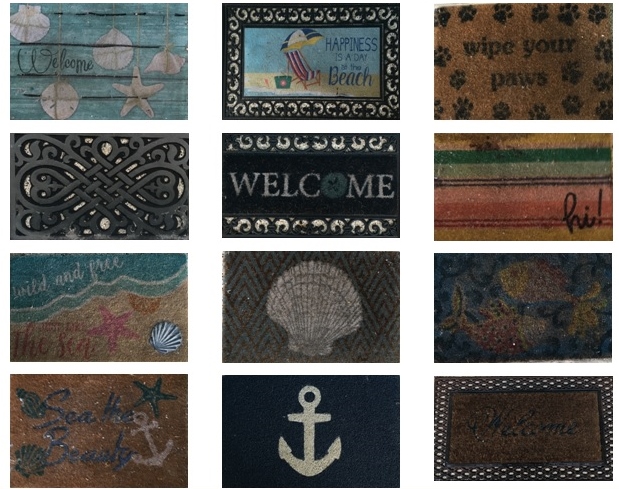
I had noticed last time that every unit here has a different kind of mat at the front door, most of them nautically themed.  I had my phone with me, so this time I took a photo of all of the mats that looked interesting.  I would have frightened someone very badly had they opened their front door and found me standing there, phone in hand, taking a picture of their doormat.  It would not have been easy to explain myself.  But fortunately everybody was snugly ensconced in their condos, as anybody naturally would be who was not (a) a dog owner or (b) not right in the head.

So here is a compilation of my photos, which I may have to enter in the next show at our local art gallery The Bascom in Highlands.  I shall entitle it, “Doormats on a Rainy Afternoon.”