Wednesday, August 9, 2023

Theodore Roosevelt National Park

The Cowboy CafĂ© was located just across the rear parking lot of the Rough Riders Hotel, and that is where two hungry travelers lined up on Wednesday morning waiting for them to open at 7:00 a.m.  Our appetites were still on Eastern Time, and the idea of a full “cowboy breakfast” was an appealing one.  The walls inside were festooned with photos of cowboys, real cowboys by the looks of them, not movie-star cowboys, tough and leathery as an old saddle.  Our plates were soon before us, generously loaded with eggs and bacon and hash browns and huge biscuits.  “Did you eat all that food?” one of Martha’s Facebook friends asked when she posted the photo.  We did not.


Our plan for the day was to drive through Theodore Roosevelt National Park on the 36-mile Scenic Loop Drive, and we stopped at the Visitors Center first.  I should mention that this was one of many National Parks where we gained free admission, rather than the usual $35.00 entrance fee, because I had had the foresight to purchase one of these lifetime Senior Passes many, many years ago (when I first became a senior).  Lifetime cards are no longer issued, only annual passes.  “Hang on to that!” one ranger told us.  “It’s solid gold!”  We estimate that the card saved us close to $500 in entrance fees throughout our road trip.


I had not realized before visiting this National Park what a conservationist Theodore Roosevelt was.  He is in fact often referred to as the first conservationist president, using his authority to protect wildlife and public lands by creating the United States Forest Service and establishing 150 national forests, 51 federal bird reserves, 4 national game preserves, 5 national parks, and 18 national monuments.  “We have fallen heirs to the most glorious heritage a people ever received,” he once said, “And each one must do his part if we wish to show that the nation is worthy of its good fortune."


The park was very beautiful, with its backdrop of tall mesas all around.  There was a replica of the log cabin where Roosevelt stayed, and as was true in all of our experiences in these National Parks, the Visitors Center was educational and the rangers were invariably informative.  “Have you seen any wildlife?” I asked, and a ranger told me that a bison had visited earlier in the morning.


We saw plenty of wildlife along the loop, including prairie dogs, wild horses, and bison, and we stopped frequently to take short hikes along the loop road. 


A particularly nice hike was up the Wind Canyon Trail to a vista overlooking the Little Missouri River.


When we returned, we realized that we had plenty of time to visit the Chateau de Mores.  This 26-room two-story frame building was built in 1883 as the summer residence of the Marquis de Mores in 1883.  The French immigrant was a famous rancher and notorious gunslinger, and his wife Medora gave this place its name.  It was a well-preserved home with many of the original furnishings.  


We also had time to visit the Cowboy Hall of Fame before dinner at a little place we had discovered earlier called Medora Uncorked.  We learned how Native Americans had hunted these huge bison on horseback with bow and arrow, and seeing exhibits of these creatures and the comparative size of the ponies used in the hunt made us appreciate even more what an incredible feat it was to take them down.  Before returning to the Rough Riders Hotel for our last night, we spent some time listening to some folk music at the Town Square played by an unassuming young man who was a very good guitarist and was also very knowledgeable about the music he played.  It was a wonderful evening, with a cool breeze blowing across the square and an appreciative audience.

Tuesday, August 8, 2023

Medora

Our hotel was located on the outskirts of Fargo in an area that seemed to be an industrial park, wide and flat and lots of pavement.  I ran a few laps in the parking lot and watched another hazy orange sunrise outside.  We were far enough north that we never experienced any of the high temperatures plaguing other parts of the west, especially Arizona, but the poor air quality from Canada lingered. 

This area of North Dakota was called the Drift Prairie Region, an interesting region between the Red River Valley and the Missouri Plateau, formed by retreating glaciers and filled with small lakes and potholes left over from melting ice.  There were fields of wheat and corn and rolling hills – it was always interesting to see changing geology on this road trip – and we also started to see more and more sunflowers, huge fields of them.  I learned that North Dakota was the top sunflower producer in the country, with a total of 625,000 acres planted, and this was the best time of year to see them.


 We did not think that this flat land had increased in elevation any, but we came along a surprising sign on I-94: Continental Divide, Elevation 1485.  It turns out this is a north-south continental divide, also called the Laurentian Divide, separating the Hudson Bay watershed to the north and the Gulf of Mexico to the south.  A humorous anonymous writer on Google explained, “To many travelers of I-94, the sign appears to be a mistake, or perhaps a self-deprecating joke dreamt up by the North Dakota Tourism Office to make light of one of the flattest landscapes in the world.”

Part of I-94 in this region paralleled a county highway known as the Enchanted Highway, a series of large metal sculptures placed along it.  We spotted one from the road called "Geese in Flight" and pulled off for a photo with the Mini, but did not have time to see the others.


We also saw a sign saying that this was Peggy Lee country.  The singer was born in nearby Jamestown, and she is remembered mostly for the song “Fever,” which I found on YouTube and played through the sound system.  (I have learned a great deal about the Mini’s sound system and its complicated computer on this road trip!)  I best remember Peggy Lee as the voice of the Siamese cats in the Disney classic Lady and the Tramp (“We are Siamese if you please, we are Siamese if you don’t please,” which remains one of the most accurate descriptions of a Siamese cat I know) as well as the sultry Pekingese torch singer Peg:

He's a tramp, but I love him Breaks a new heart every day He's a tramp, they adore him And I only hope he'll stay that way.

 
We also saw more and more windmills, as we did all over the west, and it cheers my heart to see so much renewable energy being generated where, as Dylan sings, “the wind hits heavy on the borderline.”  It was an even better harvest than sunflowers.  It was along I-94 that we also caught our first sight of two iconic western plants that we would see much of in the coming weeks, cottonwood trees and sagebrush, covering the rolling hills in shades of pale blue.

Theodore Roosevelt National Park sprawls across 70,000 acres in the “badlands” section of North Dakota, a part of which we had visited in our 2016 trip.  It is divided into the North Unit, South Unit, and Elkhorn Ranch Unit.


We approached from the east into the South Unit, and stopped at the Visitors Center, where there was a great view of the Painted Canyon, a desolate but very beautiful place, dotted with what looked like huge anthills spread out in a sea of green tinged with pinks, terrain that was much different from what we had driven through all day.


We were staying for two nights in the historic Theodore Roosevelt-themed Rough Riders Hotel in Medora, one of the most interesting destinations thus far on our road trip.  Medora was a small town, with a population of 121 according to the last census, and appears to rely heavily on visitors to the Park and surrounding area.


The hotel was opened in 1884, a year after the town was founded, and has a very nice library, mostly focusing on Roosevelt and that period of history.  We checked in early and found a Teddy Bear awaiting us in our room, which was a nice touch.


We had plenty of time to explore this small town nestled beneath high badlands-type mesas all around.  When we stepped out of the car, I told Martha, “This is the first time I feel as if we are in the west!” 


We had a pizza and some good local beers, Black Leg Centennial IPA, at Badlands Pizza, which had an interesting door-handle.


I sat on the porch and talked to some folks at a little gift shop called The White House (they don’t miss any opportunity to remind us about the one-time President) and found out they were local residents.  “I work in that shop over there,” a woman told me.  I asked about the winters here in what appeared to be hot, dry, desert country, and she confirmed that they had snow in the winter – a lot of snow – and temperatures dropped well below freezing.


Martha had signed up for an interesting live evening event just outside town called the Medora Musical, a musical revue held outdoors in the Burning Hills Amphitheater.  It was billed as:  “A little history. A little humor . . . It’s good old-fashioned family fun with thrilling variety acts, live horses on stage, a firework finale, and new twists each summer. All while celebrating the history of Medora, Teddy Roosevelt, and the historic American West.”  That is exactly what it was, and it was great fun!


We returned to the Rough Riders Hotel, later than usual for this pair of travelers still on Eastern Time here in the Mountain Time zone, to find little Teddy waiting for us next to our bed.


Monday, August 7, 2023

Fargo

We awoke to a hazy sunrise over Lake Superior on Monday morning, partly due to the poor air quality due to smoke from Canadian forest fires.  We also awoke to a Mini Cooper covered in fine, white debris of some kind, which I thought might be ash until somebody at the hotel explained that it came from tiny winged insects from the lake shedding their skin.

By mid-morning we had crossed into Minnesota.  We were already on Central Time, and in a day or two we would be on Mountain Time.  There is a real sense of traveling long distances when you start crossing time zones!  Almost a smaller version of "jet lag."


We were in Garrison Keillor country now, and we wondered if the fictitious Lake Wobegon might be nearby.  Our picnic stop for the day – we were able to find interesting picnic tables most days for a light midday lunch – was behind a church along the road equipped with a few tables and a playground.  I think it was a Lutheran church, which we had been seeing in this part of the country, but it could very well have been Our Lady of Perpetual Responsibility.  There were neat little farms everywhere, which looked as if they were carefully tended by Norwegian bachelor farmers.

We were joined way out in this unpopulated part of Minnesota by another person, a cultivated British woman’s voice from our GPS.  I use Google Maps to navigate, which despite its quirks has done a good job getting us across the country, and several months ago I tried to set the voice to a British one, just because I like the way British people talk.  All of my attempts failed, but for some unknown reason, when least expected but especially when we were far away from cell signals, a posh-sounding British voice would suddenly replace the usual American woman.  “In hahlf a mile, turn right,” she will suddenly announce.  Sometimes both voices will alternate with one another.  It's a mystery.


We crossed the Mississippi River and were surprised how narrow it was up here in Minnesota.  And we again encountered more strange names for towns:  Nimrod, Wadena.  But despite what some might call the monotonous stretches of road, we were never at a loss for conversation (about names like Nimrod if nothing else), although we did not mind riding in comfortable silence mile after mile., simply absorbing the scenery.

We tried to fuel up the Mini every day before arriving at our destination so we would not have to worry about it on long sections of road way out in the country, but we were discovering that the 93 octane premium gasoline recommended for a Mini Cooper was nonexistent in Minnesota and many other western states.  The best we could do was 91 octane, which I told Martha was like “box wine.”


We arrived in the downtown area of Fargo mid-afternoon.  The city was named after William G. Fargo, who together with Henry Wells founded Wells-Fargo, which I remember as being the name on most stagecoaches in Westerns that I watched growing up, often the victim of masked outlaws on horseback.  The other reason I knew the city’s name is from the Coen Brothers movie of the same name, in which the pivotal scene features a murderer grinding up Steve Buscemi’s body parts in a wood-chipper.  I discovered that tourists can visit a replica of the famous “Eager Beaver” wood-chipper at the nearby Visitors Center, complete with a mannequin’s leg gruesomely protruding, and it is apparently a big hit.


Instead of the wood-chipper, we opted to visit a mural in the downtown area (led unerringly by the address in our GPS) depicting one of our favorite musicians (and Nobel Laureate), Bob Dylan. 


The mural was impressively tall, and I liked the casual way Dylan seems to be leaning against the wall, cigarette in hand and the pages of song lyrics clutched in his hands.  The artist was Jules Muck, who has painted about 10,000 murals in the U.S. over the past 30 years.  Muck says she was asked to paint the mural by the owner of a new shop in Fargo and wanted to commemorate the time when Bob Dylan lived in the area.  I thought of that early-Dylan song on The Freewheelin’ Bob Dylan, which I think was the first album of his that I bought and which I played incessantly at the time:
 

If you're travelin' in the north country fair

Where the winds hit heavy on the borderline

Remember me to one who lives there

Oh she once was a true love of mine.


We had parked to take a photo of the mural and decided to look for a place to eat dinner nearby, despite the early hour (our stomachs were still on Eastern time).  Just down the street was a place called Cowboy Jack’s and the menu posted outside looked good.  A couple was just entering and we asked if it was good.  “Oh, it’s great,” they said.  “And you have to eat upstairs.”  And that’s what we did, out on a rooftop overlooking the city, in the north country fair.


Sunday, August 6, 2023

Ashland, Wisconsin

I was wakened by the urgent squealing of gulls outside, and once again I enjoyed Tai Chi on the lakeshore.  We made an early start, as we have been doing most days, and got on the road to Ashland, Wisconsin, another long day – 340 miles, nearly six hours.  There was no particular reason to stop at Ashland except that it was on the way to Fargo, North Dakota, and then to Medora where Theodore Roosevelt National Park was awaiting out exploration.  There were also some very fine murals in the city, which Martha was eager to photograph.  She is a member of a Facebook Group called “Minis and Murals,” featuring Minis photographed in front of interesting murals, and she had already found several on this trip.  We have even personally met some of the artists.


The drive to Ashland was a pleasant one on two-lane roads, first along the northern shore of Lake Michigan and then the southern shore of Lake Superior where Ashland was located. 


We passed some interesting shops, like this little country store somewhere between Germfask and Munising – these little towns had interesting names, and you knew you were approaching one only when the speed limit dropped to 45 mph near a few random buildings and then increased again.  There were also some places selling pasties, which we encountered on our trip in 2016.  The other place in the world where we have seen these hearty little meat pies was Cornwall, England, and that is because Cornish immigrants brought the pastry here in the 19th century when they came to work in iron mines on the Upper Peninsula.


We also saw another kind of shop – cannabis dispensaries – because recreational cannabis is legal in Michigan.  Some of the cannabis places even had convenient drive-through windows like a fast-food place, in the event, I suppose, that customers were unable to walk across the parking lot.  I kept an eye peeled for stoned drivers but there were few vehicles on the road.


This part of Michigan is very beautiful and very unpopulated, with plenty of hunting and fishing camps and not much else besides the oddly-named small towns.  More birches and blue spruce trees, too, and we stopped for a picnic along the lake shore, and also stretched our legs at a pretty little waterfall named Agate Falls. 


Ashland was a small city, with a population of about 2500, but Martha found some great murals on the Ashland Mural Walk before heading to our lodging for the night, a very nice Quality Inn on the shores of Lake Superior.


We were glad to discover a good Mexican restaurant at the other end of the parking lot, El Charro, and enjoyed some more healthy food.


Saturday, August 5, 2023

Minis on the Mack

Sunrise Tai Chi on the shore of Lake Huron was memorable!  I have already enjoyed practicing this morning discipline in several places on this trip, rather than on the usual deck at home, and look forward to yet-undiscovered places to come!

 
We left early so that we could get in line with the hundreds of other Minis, who were supposed to start lining up at Little Bear Arena at 6:00 a.m., but still ended up about three-quarters of the way back.  Some eager “Mini-acs” must have slept in their cars because we talked to at least one driver who was in the top ten.  We spent an enjoyable morning lined up toward the back, catching up with old friends and meeting new ones parked nearby.

The rally was supposed to begin at 9:45 a.m., and indeed the first few cars may have started around then, but it takes a lot of time to get so many cars moving!  As it turned out, 1,124 cars were counted pulling out of the parking lot, not as many as hoped for but still a good turnout.


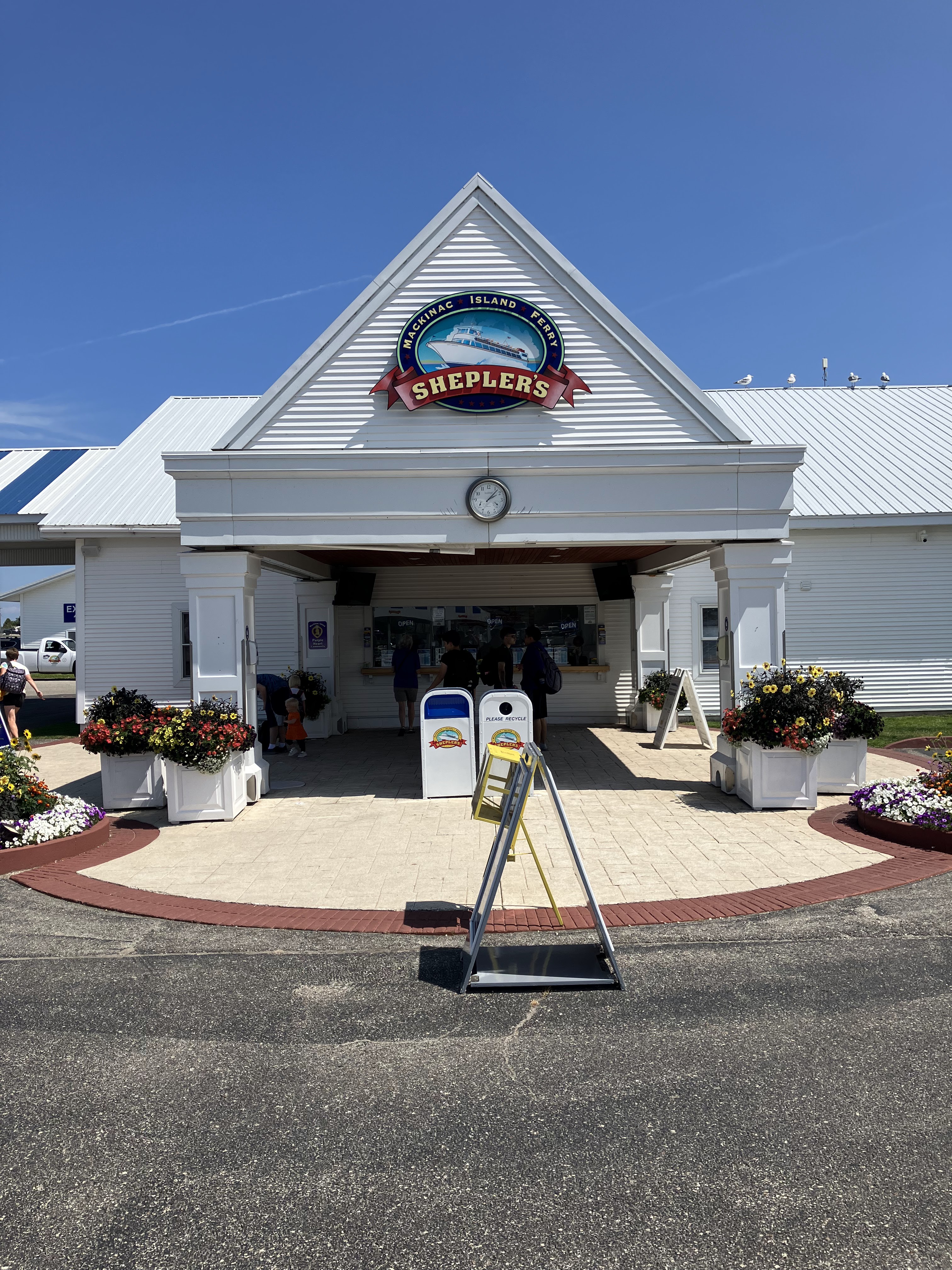
Lunch back at the arena was finished earlier than we expected, and we had the entire afternoon free.  On our “Mini Takes the States” trip in 2016, each day had included a morning meeting, an evening rendezvous, and a mid-day “Surprise and Delight,” and on this trip we kept finding ourselves discovering unplanned adventures that we came to describe as our Surprise and Delight for the day.  We had heard about Mackinac Island, which sits in Lake Huron between the Upper and Lower peninsulas, and which (according to a brochure we had found) consisted of hotels, shops, restaurants, a State Park, trails, and the 1780 Fort Mackinac, a cluster of military buildings at the highest part of the island.  We had also received in our packet the previous day a discounted ferry ticket from Sheplers, one of the oldest ferry companies transporting passengers to the island.


The main attraction on Mackinac Island is that it proudly prohibits vehicles.  The only transportation besides walking is by bicycle or horse-drawn carriage.  The story goes that when a smattering of motor vehicles first started appearing on Mackinac Island, a group of carriage men petitioned the village council to prohibit the “dangerous horseless carriages” that were frightening their horses. Village leaders enacted the ban on July 6, 1898, and it has been car free ever since.


It was a pleasant, sunny Saturday afternoon, and we enjoyed wandering up and down the main street where we had disembarked from the ferry, going into shops and checking out restaurants, while horses clattered along and bicycles whizzed by everywhere.  The Michigan Governor has a summer residence on the island, and a huge building on the hill above us, the Grand Hotel, is a well-known place that has hosted politicians, actors, entertainers, sports figures, and musicians.


I went into a bookstore and was surprised to find on shelves devoted mostly to best-sellers an entire shelf of Ernest Hemingway, before I remembered that the writer spent as much time in Michigan as in Key West.


One of my favorite Hemingway stories was The Big Two-Hearted River, about a solo fishing trip to northern Michigan.


Some of the older buildings were well-preserved, and there were costumed guides present to elaborate on their history.  We made our way up to the 18th-century Fort, explored the old barracks buildings, listened to an account of the life of British soldiers there, and watched a musket-firing display.


We were enjoying ourselves so much that we decided to eat dinner there, at a little place right on Main Street called
Verde's Taqueria, before making our way back to the ferry and across Lake Huron to St. Ignace and our hotel.  A memorable Surprise and Delight!

Friday, August 4, 2023

St. Ignace

We could have reached some of the National Parks we planned to visit, such as Theodore Roosevelt and Yellowstone, a lot earlier than we did.  The main reason we did not is that we took a detour northward to St. Ignace, Michigan, to attend a rally of Mini Coopers called “Mini on the Mack.”  Organizers of the annual event hoped to break the English-held world record this year for the largest-ever MINI Cooper parade, crossing the iconic Mackinac Bridge.  We had crossed the bridge on our 2016 trip (“Mini Takes the States”), but we wanted to do it again and to meet up with hundreds of other “Mini-acs.”


So instead of heading due west from Indiana Dunes, we went north, 350 miles through Michigan on pleasant two-lane roads along Lake Michigan.  It was an interesting slice of America as we passed through small towns and past peculiar sights, such as this one outside a diner somewhere north of Grand Rapids. 


We began to see slender white-trunked aspen trees, which reminded me of the white birches in Vermont, and blue spruce.  There was a sign for Saginaw, and it reminded me of that Paul Simon song that had also been playing in the back of my mind since this trip began, about two young lovers marrying their fortunes together

"Kathy", I said as we boarded a Greyhound in Pittsburgh "Michigan seems like a dream to me now" It took me four days to hitchhike from Saginaw I've gone to look for America.


There were signs for snowmobile crossings, too, a reminder that this part of the country gets a great deal of snow.  On our 2016 trip, we had toured a snowmobile museum somewhere in this part of the country.  We were also seeing more and more Mini Coopers on the road as we neared St. Ignace.

Finally, we arrived at Mackinaw City and drove onto the Mackinac Bridge.  It is a peculiar word, spelled two different ways but pronounced the same – “mack-in-awe” – and the reason is that it is a shortened version of the Native American name, Michilimackinac, meaning place of the great turtle (they thought the limestone bluffs of Mackinac Island looked like a giant turtle rising out of the water).  When present-day Mackinaw City was founded in the 1850s, the British changed the spelling of the city to reflect the way the name is pronounced, with a “w” sound at the end.


However it is pronounced, the bridge is an engineering marvel, dwarfing the 3030-foot New River Gorge Bridge we had seen three days ago.  This bridge spans open water from the lower to the upper peninsula (‘the “U-P”) and is 26,372 feet long, just a little short of five miles.  It was opened in 1957 and at the time was the longest suspension bridge in the world (it is now the fifth).  For those who are interested, there is an interesting YouTube documentary on its construction called “Building the Mighty Mac.” 


We checked in at Little Bear Arena, which we remembered from our 2016 trip, to pick up our packet and found ourselves amongst hundreds of other Minis, no two alike, and many of them decked out for this event.  We met several folks, such as Jeff from Greenville, who had been at the gathering of Minis at Fontana Dam in May called “Mini on the Dragon,” where we had driven in small groups on the famous “Tail of the Dragon” and Cherohala Skyway.  We enjoyed looking at the cars and meeting other owners most of the afternoon.  In a lot of ways it was like picking up race packets at a marathon or other big race, mingling with the other runners, getting ready for the exciting day ahead.

We had dinner at the Mackinac Grille, and then drove to Castle Rock, a limestone rock formation three miles north of St. Ignace.


There we climbed the 170 steps to its summit – that was good exercise! – before checking in to the Holiday Inn, right on the shore of Lake Huron and reminiscent of oceanfront hotels where we have stayed over the years.  Very nice! – Martha has outdone herself in finding good places to stay.  Our overall mileage by the end of the day was 1,325,


Thursday, August 3, 2023

Indiana Dunes National Park

We spent a quiet night in Shady Oaks Farm, and I awoke early for my morning Tai Chi out in front of the still-slumbering house.  I had asked Melanie where I might be able to run in the morning and she told me to try All Saints Cemetery just down the road.  It was a peaceful morning and there was little traffic on the road, and like the dinner last night, Melanie’s recommendation proved a good one.  A healthy and delicious breakfast had been prepared for us, which Jeff served to us in the dining room, and then we got on the road early.

From Northfield, we continued through Ohio and into Indiana, flat country with lots of crops, mostly corn.  In this open country, farmhouses had been built beneath the shelter of tall trees, and even though some of them had collapsed and been abandoned over time, the trees still stood marking the spot.   


I kept thinking of that Chrissie Hynde anthem to Ohio:


I went back to Ohio
But my city was gone
There was no train station
There was no downtown
South Howard had disappeared
All my favorite places
My city had been pulled down
Reduced to parking spaces
A, o, way to go Ohio


The city referred to in the song is her hometown of Akron, Ohio.  South Howard is a section of Howard Street in Akron that was bulldozed to build the Innerbelt, a spur of highway that borders the downtown area.  Hundreds of businesses and homes were demolished in the process, and her bitterness is shared by many of the local residents who were displaced.


We arrived at Indiana Dunes, another National Park I had never heard of, early enough in the day to explore. 


We knew we were close to Lake Michigan, and I had wondered what kind of “dunes” we could find here in the Midwest.  What a surprise to discover a beach, right here in Indiana.  The nearest beach on the east coast (New York) was over 700 miles away and a 10 or 12-hour drive, so this was the best option for anyone living in the Chicago area.  We walked out past a large Visitor Center/dressing area, similar to the one we know well in Atlantic Beach NC, and down to the beach itself, which in every respect resembled the beaches we knew except the water was Lake Michigan, and I am assuming there was no “seafood” out in that broad blue body of water.  There were sunbathers, children playing, and lifeguards.  The water temperature was 75 degrees, and there were indeed real sand dunes, although of course no seashells.  Gulls flew overhead – “lakegulls” I suppose. 


That’s the skyline of Chicago in the lower picture, and it was strange to see that great Midwest city, which we consider land-locked, hazy and mirage-like over the sand.


We drove through Michigan City to our lodging for the night, another interesting place Martha had identified called the Brewery Lodge and Supper Club.   


The hotel only has 12 rooms connected to the “supper club” section, and is located on a 40-acre wooded tract.  The main house dated to 1930 and had hand-hewn timbers and fireplaces, and the food was delicious.  It is also nice to be able to walk to your room after dinner instead of battling traffic in a strange city.