Saturday, July 16, 2022

Lunch on the Seine, Champagne at the Crazy Horse

We had become familiar with the restaurants on our street, some of which I have referred to in this blog, but I think it was today that we ventured across the street to the lavarie, or laundromat.  Beginning on Sunday, we would be on the road with the tour group for several days, so this would be a good opportunity to catch up on laundry.  All of the signs in the lavarie were in French, however, which I was having trouble translating, and at one point we somehow started a washing machine filled with soapy water but no clothes.  From a tiny room in the back of the laundry, a woman suddenly emerged, her black hair tied high in a scarf and a twinkle in her eye.  I told her, as I have been telling many Parisians so far on this trip, “Mes excuses! Ma Francais est tres mauvais.”  She said, “Oh no, Monsieur your French is good!  (I always loved hearing that!)  It is my English that is bad!”  But somehow we reached across the language barrier of bad French and bad English and managed to complete a load of laundry.

Today Martha had scheduled for us a luncheon cruise on the Seine on one of the many boats that cruise up and down the river.  It was an experience we had been looking forward to, and our appetites were keen.

I always think of that lovely, bittersweet Judy Collins song when I think about the Seine, and it was going through my mind this morning:

 My father always promised us
That we would live in France
We'd go boating on the Seine
And I would learn to dance

I sail my memories of home
Like boats across the Seine
And watch the Paris sun
As it sets in my father's eyes again

We arrived in plenty of time, and had seats at a table for two directly on the water.  Our attentive waiter began the luncheon with a glass of champagne, and then brought some very good white wine with the appetizers, and then some very good red wine with the main course and the dessert.  I wish I had taken more detailed notes about the food!  Let me just say that, while we do not often eat “gourmet” food, Martha and I have had our share of delicious dinners at restaurants near and far, and without a doubt this was the best lunch I have ever experienced.  Healthy, absolutely delicious, and beautifully presented.  Photos never do justice to good food but I tried anyway.


While we were eating and drinking, our waiter described to us the sights we were seeing along the river, parading slowly by us as we passed under one beautiful bridge after another, one of them I am sure the Pont des Arts, our humble lock dangling from its railing and our key in the water below us.

Did we attempt the three-mile walk back to the hotel?  Merci, non!  We took a taxi – there seemed to be a great many of them waiting for diners to emerge from the boat.

At this point, let me mention the taxicabs in Paris.  We had taken several so far, and they were invariably terrifying.  The road is filled with bicycles, motorized scooters, and other cars, all entering intersections at the same time and by some miracle exiting unscathed.  The horn is used sparingly, but very effectively.  We have seen roundabouts in the UK, and they are becoming more common in our country now.  The "roundabout" at the Arc de Triomphe was simply a broad, six- or seven-lane circle of cobblestones, unmarked by any lines, into which taxicabs hurtled around in a counter-clockwise direction, narrowly avoiding one another.  Absolute chaos!  We would learn from Bruno (our tour guide) in a few days time that he had a French driving license, and that the test was simply to drive around the Arc de Triomphe five times and survive.

The day was not finished, however.  “A trip to Paris would not be complete,” Martha had told me a few weeks ago, “Without . . . a visit to a cabaret!”

What good is sitting
Alone in your room?
Come hear the music play
Life is a cabaret, old chum
Come to the cabaret

I was not sure what to expect.  I envisioned petticoated can-can dancers and a burlesque music hall environment.  So I was glad that Martha had found, not the overwhelming three-hour-long Moulin Rouge experience, but a smaller, equally historic cabaret called the Crazy Horse.  It’s website said:  “Le Crazy Horse Saloon or Le Crazy Horse de Paris is a Parisian cabaret known for its stage shows performed by female dancers and for the diverse range of magic and variety 'turns' between each show.” It had been founded in 1951, and was known for spectacular choreography.


The girls were, well, shall I say . . . athletic, and they were not entirely nude, but very close to it; it was not for children or for the prudish.  But I have to say that it was at all times tasteful, not lewd, celebrating the beauty of the human body in a series of  performances that almost reminded me of the Cirque de Soleil.  And it was very funny as well.  I took this photo of our hostess before she warned us all that no photographs were allowed.  “Enjoy with your eyes, not with your phones!”


After the show, we went next door and had some delicious pizza at a genuine Italian restaurant called Cantina di Luca.  And what a surprise, again! – a delicious, generous-sized margherita pizza and two glasses of fine rosé wine for only €25.00,  No tax, no gratuity.  Paris is filled with expensive white-table-cloth restaurants, but as I have said earlier, one can dine very well here on a budget.

There is another song about Paris, a World War I-era song – I think Judy Garland covered it – that I thought of after having visited the Crazy Horse:

How ya gonna keep 'em down on the farm
After they've seen Paree'
How ya gonna keep 'em away from Broadway
Jazzin around and paintin' the town

How ya gonna keep 'em away from harm,
That's a mystery
They'll never want to see a rake or plow
And who the deuce can parleyvous a cow?
 

Friday, July 15, 2022

Musée du Louvre

One of the special events that Martha had booked for us during our time in Paris was a guided tour of the Louvre Museum, the first of many adventures on this our third full day in Paris.  We had scheduled a taxi to arrive at our hotel at 9:00 a.m. and take us to the Arc de Triomphe du Carrousel, a monumental arch with a horse-drawn chariot on top, situated across the road from the courtyard of the Louvre, just south of the Jardin du Tuileries.

The extensive buildings all around made it clear that one could spend a lifetime touring this place, but at least we would have half a day with a professional guide.  In the courtyard we saw the famous Louvre Pyramid, a large glass and metal structure designed by the Chinese-American architect I. M. Pei, which serves as the main entrance.  The Pyramid was controversial at the time it was erected, but is now a landmark of Paris, the centerpiece of a renovation called the Grand Louvre project begun in 1981.  It consists of 70 triangles and 603 diamond-shaped glass pieces installed, one by one, on a structure made of 190,000 pounds of steel and 210,000 pounds of aluminum.


Lines were already forming in the courtyard, tourists who would stand for two or three hours in the sun waiting for admission.  So I was glad that our tour promised to give us “skip-the-line” access and an English-speaking guide.  We descended nearby steps into the entrance below where an inverted pyramid admitted light from above - both beautiful and impressively functional!

Our guide for the tour was Natalie, a poised, mature, elegant-looking woman who seemed to be familiar with every single object in the museum.


She must surely hold a doctorate in art history, I realized, as she took us through room after room of art that was absolutely jaw-dropping, explaining in details its origin and significance.

We went into one gallery after another, so splendid that it is difficult to describe within the humble confines of this blog.  It was as if my eyes were at a memorable feast, and by the end of three hours I could not hold another bite of beauty.

“There is so much to choose to show you,” Natalie said at one point, “So I will choose this room!”  We entered a long gallery which was lined on both sides with four-meter high paintings, which I learned was called the Rubens Room, or the Galerie Médicis.  It contains the complete series of paintings of the life of Marie de’ Medici by Peter Paul Rubens, one of the greatest painters of his time.  She was the widow of King Henri IV and the mother of King Louis XIII, and each painting represented episodes of the queen’s life.  One by one, Natalie took us around the room, pointing out historical and symbolic features in the paintings that would have completely escaped us had we, like some of the tourists we saw, been on our own, wandering aimlessly from room to room.  At one point some members of our tour group sat on benches in the middle of the gallery to rest (we had ascended and descended many stairs!), and clearly annoyed, Natalie gestured to them to get up and said, “We are here to see great art, not to relax!”

 
We also saw two very famous classical Greek sculptures, the Venus de Milo and the winged Victory of Samothrace, or the Nike of Samothrace.  Crowds had begun to increase by this time, and it was difficult to make our way around these rooms.


Finally we reached the room to which most visitors of the Louvre are drawn, the famous painting of the Mona Lisa by Leonardo da Vinci.  “Considered an archetypal masterpiece of the Italian Renaissance,” Wikipedia says, “It has been described as ‘the best known, the most visited, the most written about, the most sung about, and the most parodied work of art in the world.’”  At the far end of a line zig-zagging back and forth before us hung what seemed to be a very small painting, permitting the patient visitor only a few seconds to take a photo, often a “selfie.”


I would never belittle a painting that is clearly a masterpiece, but there is no doubt that there is a lot of hype about what is one of many, many masterpieces hanging in this museum.  I have read about the mysteries surrounding the portrait of Lisa Gherardini, wife of Francesco del Giocondo, such as the way the background on either side doesn’t seem to match up, and why she is wearing no wedding ring.  But it is that enigmatic smile, of course, which causes the most speculation.  Is she sharing a private joke with the painter?  Is she sneering?  I like to think that she is looking ahead into the future, and is amused at these long, long lines of visitors coming to see her.


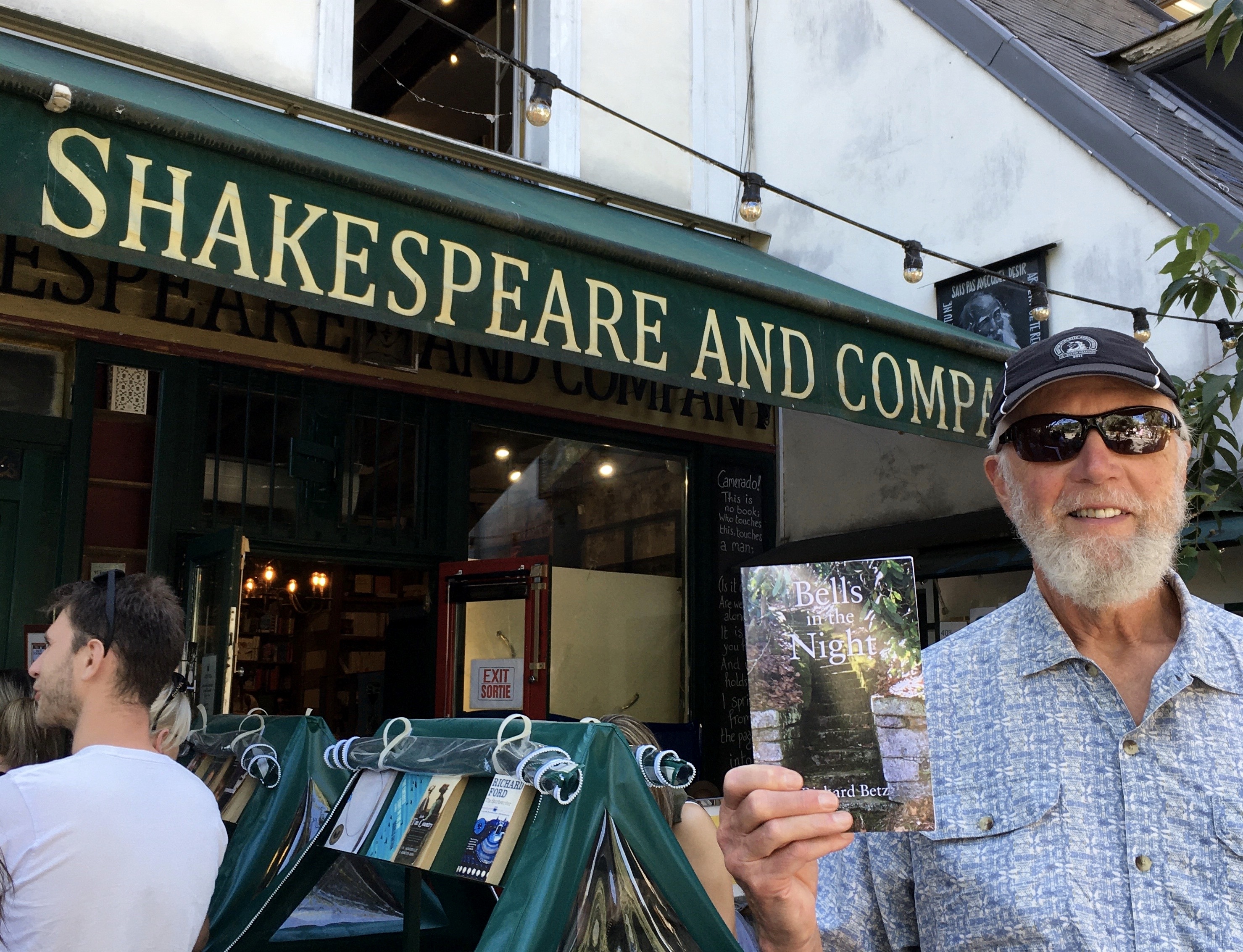
We gratefully thanked Natalie after the tour and made our way back to the Jardin du Tuileries, this time having lunch at another outdoor café – smoked salmon and emmental cheese quiche and a welcome bière pression. (They do have some surprisingly good beers in France, although we had yet to discover any IPAs so far).  Realizing how close we were to the Left Bank (La Rive Gauche) and the Latin quarter, home of the original Shakespeare and Company bookstore and inspiration for our local bookseller in Highlands (see yesterday’s post), we had planned to cross the Seine and explore the area.  The book store is a famous one, opened in 1951 on the site of Sylvia Beach’s bookstore of the same name, famous for publishing Joyce’s Ulysses and as a hangout for Americans of the Beat Generation.  There were long, long lines waiting for admission to the little store, which we finally located deep in the maze of tiny streets in that part of Paris

My book of poetry, Bells in the Night, was published last year, and our own local Shakespeare and Company had graciously hosted a book signing there.  Thinking of that event, I had brought a copy with me, and Martha took this photo of me outside the store.  I had wanted to go in the store and hide it on a shelf somewhere, but I was not willing to wait in line for an hour to do so.  There used to be a tradition where so-called “tumbleweeds,” vagabonds traveling to the book store, could sleep there at no cost provided they agreed to volunteer there and to read a book every day.   But today the store was too crowded for that blissful time when Allen Ginsberg and Ernest Hemingway graced its narrow aisles.


We spent some time in the area, walking the narrow streets of the Latin Quarter with its many shops.  It was here that I found something I had been looking for, a hat – a French hat, I told myself, although not a beret (to which I am philosophically opposed) – which I wore for the rest of our time in France.


We participated in another tradition in Paris on this day, too, crossing the famous Pont des Arts bridge across the Seine, where generations of couples have shared a tradition of attaching “love locks” to the bridge and tossing the key in the river below in symbolic acts of affection.  Alas, the City of Paris started removing padlocks from the bridge in 2015 due to concerns about the weight (there were literally tons of locks attached to it).  


Still, visitors manage to find a way, hanging them on temporary cables which I suppose are removed from time to time, or high on the ornamental street lights on the bridge.  We had brought a lock for this purpose and there it hangs to this day, the key thrown into the waters of the Seine.


It had been a long day, and we took a taxi back to our hotel.  Because of Bastille Day, Que pour les Gourmands was not open, but we found a little patisserie up the street in the opposite direction, Le Grenier a Pain Tocqueville, where we bought two delicious, braided baguettes, one containing mozzarella and tomato and another olives, and brought them back to the hotel.  We had discovered that the courtyard in the hotel was very, very quiet, since it was totally enclosed, and we had it to ourselves at that time of day, a welcome moment of tranquility and silence after the hustle and bustle of the crowds at the Louvre and in the Latin Quarter.

Thursday, July 14, 2022

Bastille Day

Stuart Malcolm Ferguson, who runs an independent book store in Highlands and is my Facebook friend, posted this a week ago.  “Le jour de gloire est arrivé! In honor of our Parisian namesake, come celebrate Bastille Day at Shakespeare & Co. Booksellers in Highlands Village Square on Thursday, July 14, from 4 to 6pm. We'll have live music, light refreshments and rude salesclerks--just like the City of Light!”  It was a little cruel of me, but I replied, “Sorry to miss it Stuart! We’ll be in Paris on Bastille Day!”  (And by the way we never encountered any rude salesclerks.)  “Zut alors, that's rubbing it in!” he said.

We had been cautioned by more than one Parisian, beginning with our taxi driver from the airport on the first day, not to go out into the city on July 14, or if we did to wait until apres-midi (afternoon).  There were many, many people lining the Champs Elysees – at least, that’s what I saw on TV in the lobby of our hotel, where I watched some of the parade this morning, including Emmanuel Macron waving from an open car.  Pickpockets are always a problem in Paris, although we never encountered any (and our securely-zipped pockets would have foiled them), so perhaps that is why we “Innocents Abroad” had been told not to venture out.

The 17th Arrondissement was far from the Champs Elysees, though, and we felt perfectly safe walking the shady, quiet one-mile route to the Parc Monceau, which Jean-Charles had showed us yesterday.  I should mention at this point that whenever we walked somewhere in Paris, we felt safe.  There were always other people around, and perhaps I am just naive, but I am not sure the French even have a word for “mugging.”   The sidewalks are wide and  the roads are well-maintained, and everywhere you go you see amazing architecture, iron railings and streetlights you might expect to see in a museum, and unexpected statuary.  Here is a bank we happened to see along the way.  Just an ordinary office building.

Near the entrance to the park was the museum Jean-Charles had pointed out to us yesterday (he had checked to be sure it was open on this national holiday), the Musée Cernuschi, officially the Musée des arts de l'Asie de la Ville de Paris, one of the best Asian art museums in the world.


We both love Asian art and we spent some time there, then entered the park, which today was filled with Parisians relaxing, strolling along the tranquil, shady sidewalks, and spreading out blankets on the lawn in the sun, as we would do on the Fourth of July in the US.  (A first-class fireworks display was also scheduled for later in the day – as well as military jets flying in close formation like the Blue Angels, streaming vapor trails of red, white, and blue – but still suffering from jet lag and having walked perhaps six miles by the end of the day, we did not stay up to see it.)  It was a popular place for running, too, with wide walkways and no traffic.


There were many children in the park, especially in the vicinity of the carousel, which was similar to ones in our country but somehow seemed different, seemed French,  Perhaps it was the Jules Verne miniature submarine, or the long-eared donkey.

Here is a video I shot of the carousel, and in the background you can see a small round building selling cappuccino, iced drinks, gelato, and pressed sandwiches, so small that it was hard to believe all of those operations were being carried out in the one building.  We ordered the sandwiches, made with fresh tomatoes and mozzarella, and sat at a tiny table out back, and it was very good.  One detriment to eating outside, however, is that smoking is allowed, a habit that is surprisingly widespread in France.  It seems like such a healthy country in so many other ways, its citizens for the most part slim and attractive – we rarely saw the obesity that is such an epidemic in our country – and Jean-Charles had commented on the smoking yesterday as well.  “It is one area where you are ahead of us!”

We wandered and wandered, up one street and down another, a little like Ulysses.  We were enjoying being in Paris on our own, and we were feeling very self-reliant.  We ended up on the wonderful Rue de Lévis, with its many food stalls and shops.  Not far from our hotel at this point, we decided to buy some wine and went into a wine shop, called a cave.  A very likeable young woman who spoke excellent English guided us to a good choice, and I mentioned that we were also looking for a pâtisserie – a bakery – for some good bread.  “The one we just passed?” I asked.  “No, no.  Go down the street that way and there is a little place on the right!”  There was indeed, and the bread was excellent.

Between there and our hotel there were plenty of ethnic restaurants  – Vietnamese, Argentina, Portuguese, Chinese – reflecting the ethnically diverse nature of this city.  I learned that Paris is considered the most diverse city in Europe; it is estimated that around 23% of the population migrated to the city sometime after they were born.  I am sure there are some problems here, but it is a rebuke to that dangerous and narrow-minded belief that one's own race happens to be the superior one.  Travel just a little and you will learn that there is always someone of another race or ethnicity who is richer, stronger, faster, smarter, and better looking than you are. 

Wednesday, July 13, 2022

Running with Jean-Charles

After we had unpacked at the hotel yesterday, we walked across the street to a little sidewalk café called Que pour les Gourmands.  We struggled with the French a little, but the jolly young waiter was very patient, and we ordered some appetizers (including salami, cheese, and a Terrine de Canard – duck Pâté, which I sampled only enough of to be polite), the Salade Gourmande du moment (salad of the day), and some good white wine at €5.00 a glass.  The exchange rate varies daily, but a euro is about equivalent to a dollar.  We found that both the food and the wine were very inexpensive; you can dine well in France on a budget.

Tai Chi on the balcony was a bit of a challenge, a narrow space with a low railing eight floors above the Rue de Tocqueville, but I don’t like to miss this daily ritual and never did the entire time we were traveling, even if practiced in a tiny hotel room.  The street was remarkably quiet, the air cool and still.  We went down to breakfast – La Petit Dejeuner – and I was proud to be able to tell the hostess our room number, “Dix cent trois.”  What a bountiful spread! - consisting of my morning staples muesli (granola) and soy milk (lait de soja), fresh-pressed orange juice (plus four other juices), yogurt, fresh fruit, dried fruits and nuts, apricots, figs, prunes, jams and jellies, a fresh baguette of bread which you could slice yourself, croissants, and some other delicate, flaky breakfast desserts.  We have never had croissants so light and flaky!  The hostess had to show me how to make the coffee, flat flying-saucer-shaped little pods placed in a machine sort of like a Keurig which produced frothy French coffee or espresso, depending on the setting.  There was also a basket of eggs and a pot of boiling water (which I had not noticed but Martha had) next to it.  On Sunday, a woman on our tour, assuming they were all hard-boiled, took one to her table and broke the shell, releasing fresh raw egg all over her plate.  “I would not be a bit embarrassed,” I told her.  “You’ll be telling this story back home for years and laughing about it!”

After breakfast, we embarked on an adventure that I mentioned in an earlier post.  Since we were in Paris for five days before joining our Tour group, Martha had found and booked some very good experiences, and they actually turned out to be the highlights of our time in Paris.  This morning we went down to the lobby and met in person (we had been e-mailing him) Jean-Charles Sarfati, who is the owner/operator of Paris Running Tours.  He was a friendly and enthusiastic man only a few years younger than I am, and he took us on a three-mile orientation run from the hotel all the way to the River Seine – the perfect thing for jet-lagged legs, and a great orientation tour of Paris.  (And what else would you expect of Highlands Roadrunner on our first day in Paris?)  He was an experienced marathon runner, completing the Paris Marathon every year, and was going to Japan later in the year to run the Tokyo Marathon with his son who lives there.  He had also runs marathons in the US, and is planning to run Boston next year since he qualified.  He was willing to slow the pace down for us, and we stopped frequently while he pointed out various sights and took photos. 

Martha posted a five-star review on Tripadvisor when we returned:  “Jean-Charles met us at our hotel on our first day in Paris, and took us on a wonderful orientation run around Paris.  He was very informative, and shared some fascinating historical details along the route.  He also took many photos, which he later dropboxed to us on the very same day.  It was a pleasure running with Jean-Charles, and we are happy to recommend him and give him the 5 stars he deserves!”

I mentioned Rue de Tocqueville, and he knew very well that it was named after Alexis de Tocqueville, who wrote Democracy in America in 1835.  I cannot begin to describe all of the fascinating details of history, culture, and architecture that he told us about.  “You know about Haussmann architecture?” he asked, and I confessed I did not.  All of the buildings on this street and many in the 17th Arrondissement were designed by Baron Georges Eugène Haussmann, who famously modernized 19th-century Paris.  The buildings almost always had balconies on the second and fifth floors, the second floor being where the wealthier residents lived, servants upstairs.  We ran southward to the lovely Parc Monceau only a few blocks away, a great place to run, and a nearby (free) Asian art gallery, both of which we would visit on Thursday.  He even pointed out the unattractive street trash cans, unenclosed since the terrorist attacks of a few years ago so that bombs could not be concealed there.

 
He took us down the famous Rue de Lévis, a pedestrian shopping street lined with fruit stands, butchers, fishmongers, wine stores (caves), boulangeries, patisseries, brasseries.  This is where I would shop if I lived in this beautiful city, picking up a baguette or two of bread every day, a bottle of rosé, and perhaps a small quiche.


We made our way eventually to the Petit Palais and the Grand Palais, the latter used for large exhibits but the smaller a very fine museum with high painted ceilings and gorgeous statues, as well as a small cafe in the courtyard where we would have a glass of wine later in the day. 


We finished our run in the Jardin de Tuilleries on the other side of the Champs Elysees, where bleachers and barricades were being set up for tomorrow’s Bastille Day parade, and would remain in place for the final stage of the Tour de France (on rough cobblestones that I would not want to negotiate on a bicycle under any circumstance, but especially not on the 21st stage of a 2,068-mile race),

There was a significant armed police presence in the area, especially in the vicinity of government buildings, and we often saw groups of three men in uniform (always two in front, one behind) carrying G-36-style assault rifles.  Once I noticed that one of the soldiers was a woman, a very attractive woman who would have looked more at home in the nearby Chanel store, but not someone I would want to cross.

Jean-Charles had recommended for lunch the restaurants in the Tuilleries, and we found ourselves seated outdoors under shady umbrellas eating delicious sandwiches and draft beer (bière pression) to satisfy thirsty runners on what had become a warm afternoon.

Afterwards, we made our way back slowly to our Hotel, stopping at the Petit Palais for that glass of cold white wine.  And thanks to our orientation tour we managed to find our way back easily.  Alors:  a three-mile run-walk on our first day in Paris.  Parfait!

NOTE:  Jean-Charles, if you are reading this, mes excuses for abbreviating so much of your interesting tour of Paris, and for quite possibly misspelling most of the words that still reside in my high-school-French memory.  And good luck in Tokyo and in Boston – Courir Fort!


Tuesday, July 12, 2022

Arriving in the 17th Arrondissement

One day slides into another when we travel through time zones and across wide gleaming oceans, and today we found ourselves in a new country and a new day.  Although technically Britain is part of Europe, flying across the English Channel seems to cross a border of a different kind entirely, onto the continent, and a country that speaks a different language and has an entirely different culture than we experienced in the United Kingdom and Ireland three years ago.  We were in the EU!  We carried with our passports a new form which we had obediently printed out, the EU Digital Passenger Locator Form (dPLF), which bore a QR code and identified our temporary address as Paris, Rue de Tocqueville 118 75017, and which we were never asked to show any authority during the entire time we were in France.

While waiting in Heathrow Airport for our flight to Paris, I had been surprised as I had been three years ago at the many races, ethnicities, and cultures all around us.  It makes one feel provincial!  I was sitting on a bench waiting for our flight to Paris and noticed a young woman near me wearing a head covering who was carrying on a series of conversations on her phone in what seemed to be at least four different languages, one after another.  She finished her calls and struck up a conversation with us in excellent English, and we learned that she was a doctoral student pursuing cancer research; originally from Turkey, she had traveled widely in the US for her education.  What a bright and personable young woman!  Surely she is the hope of the future in finding a “cure” for this disease, although in our conversation we agreed that it was unlikely that there would be a magic bullet, that cancer was likely caused by many factors including lifestyle and environment. 

One of the things this woman told us was that her baggage had been delayed for two weeks recently, and we tried to imagine how such a calamity would affect us.  Two weeks from now we planned to be on the last leg of our voyage, on the way to Mont-Saint-Michel and the Normandy Beaches.  But a very sharp young man at Charlotte Douglas had taken a look at our itinerary and said he could get our bags transferred to Paris so we would not need to claim and then re-check them in Paris.  “I’ve tried three different ways,” he had said with some frustration as he wrestled with his computer, before telling us confidently that he had worked it out.  Could we trust him?  We made our way immediately to Baggage Claim.  There are few sights more welcome to a traveler than the appearance of one’s humble piece of baggage on the conveyor belt, safe and intact, making its way slowly around the carousel.

Charles de Gaulle Airport was a beautiful, modern airport, and passing through security was much easier than Heathrow.  The concourse was filled with the luxury shops which we would become accustomed to seeing in Paris:  Prada, Louis Vuitton, Cartier, Hermes, Gucci, Chanel.  And of course, everybody was talking French.  We had been advised by Trafalgar Tours,  “Make your own way to the hotel at your own expense.  If using a taxi, ensure that it is an official taxi from the rank outside the Terminal Building.  By law these must have a ‘Taxi’ sign on the roof and a taxi meter.”  We found a taxi meeting those requirements immediately, driven by a friendly and talkative Asian driver named, I think, Hai.

When I say “talkative,” I mean that he spoke about as much English as I spoke French.  This was my first attempt to carry on a conversation with a French-speaking native and I was proud of myself and grateful for Miss Satterlee grounding me in the basics of the language.  Over the next few weeks, I would find that my vocabulary seemed to bloom and expand; long-forgotten words came to me easily, rising to the surface and surprising me.  It was a good time to visit, Hai told us, because all the Parisians were on vacation, or vacance.  This was la grande vacance, he said proudly, which could be as long as deux mois.  “Two months!” I said.  “We are lucky to get two weeks in our country – deux semaines.”  He laughed.  “Oh, we have that, too, la petite vacance, deux semaines.  We don’t like to work as much as you do.”  Paris was consequently filled with tourists, which made business good and driving a taxi profitable.  

It was rush hour in Paris – heure de pointe – and traffic was heavy.  I was struck by the beautiful modern architecture all along the way, the modern well-designs roadways, and by the complete absence of pickup trucks and large SUVs.  Everybody seemed to be driving compact or subcompact cars, which is understandable when gasoline (sold in liters) is the equivalent of $7.50 per gallon.  (Yet for some reason, French residents do not feel inclined to post stickers of Emmanuel Macron on fuel pumps blaming him for the high prices.  Instead they buy smaller cars.)  We arrived at our hotel somewhere close to six or seven o’clock, the Hotel Mercure, located in a relatively quiet part of Paris, the 17th Arrondissement.

We were relieved to be checking into a hotel after many, many hours without sleep.  The room was small, as we had expected in Paris, but since we were arriving five days before the Trafalgar Tour was scheduled to begin, Martha had booked a room on the eighth floor (“Etager huit!”the elevator announced) with a narrow balcony overlooking the Rue de Tocqueville below us.  Across us were eight- and ten-story buildings with metal mansard roofs from which picturesque chimney pots protruded, and off to the south a portion of a long, green park called Parc Promenade Pereire, where an abandoned railway had been converted into a pedestrian greenway.


We had gone out onto the balcony immediately when we arrived, and we shortly discovered that the air conditioning was not working in the room.  But Guillame, a tall friendly young man on the front desk, came upstairs and quickly solved the problem.  When the balcony door is opened, he said, and not shut entirely, with the handle turned down, the air conditioning does not work.  Which after all was entirely sensible.  As most things in France, we would discover over the next few days, seemed to be.

Monday, July 11, 2022

Miss Satterlee's Student Goes to Paris

I am posting this on July 31, one day after our safe return from France.  Over the next few days I intend to bring my handful of followers up to date, day by day, on the adventures we experienced this month.  It is typical summer weather here in Highlands as I write, hot and humid, afternoon thunderclouds gathering in the west, and I am weary from the lingering effects of jet lag and Covid (more about that unfortunate turn of events later).  It never rained once while we were in France, so it is good to see such a lush and green world outside the window.

But before I begin my tale in earnest I have to talk about Miss Satterlee – Rebecca Satterlee, that is – my high school French teacher.  Until I unearthed my high school yearbook, I did not even remember, or perhaps never knew, the first name of this remarkable teacher from whom I took three years of French 55 years ago.  On our first day in class we were instantly immersed in this language, which is after all the basis of 30 percent of our English vocabulary today thanks to the Norman Conquest in 1066 A.D.  Miss Satterlee would not allow us to speak anything but French in her class, which was a bit of a struggle at first but soon became a challenge and ultimately a triumph of accomplishment.  If we wanted to know a word in French, we would have to ask, “Comment dit-on ‘chair,’” for example, and she would say, “On dit, ‘la chaise.’”  We sang Christmas carols in French, we learned which nouns were male and which were female, we learned slowly and tediously how to conjugate verbs.  And at the end of three years, we went to the home of a class member and had a sumptuous French dinner, which included, mousse au chocolat and, yes, escargots.  And we could speak French!  What an amazing thing it is to learn a language, the earlier in life the better, and to find it still embedded deep in the brain all these 55 years later!  Because yes, I discovered to my surprise that my French was surprisingly passable after half a century.

There she is in my high school yearbook, seated, third from the left, and now I realize that she was the chairman of the department.  At the time, we thought she might be a spinster, but now I see that she was a young woman, with an impish smile and a pixie hairdo, probably only a few years older than I was.  So thank you, Miss Satterlee – merci beaucoup!

On Monday morning, our bags already packed (one checked suitcase, one carry-on), we drove the three-and-a-half miles to Charlotte Douglas International Airport, one of the busiest in the country for passenger flights, with 700 flights each day.  That works out to about 30 per hour, one every two minutes, and when we arrived at the nearby Holiday Inn (were we parked our car for three weeks) we could hear the exciting, constant roar of aircraft taking off and landing.  I suppose those who fly regularly for business or pleasure may become accustomed to flying, but for a relative novice like myself it is still thrilling to experience this miracle of modern transportation as a 90-ton aircraft lifts effortlessly into the sky.

Our flight was on time, and checking our baggage and going through security was easier than we had expected.  In no time at all we were in the air, 38,000 feet above the North Atlantic, the outside air temperature in the minus 40s.  I always take Dramamine and have never been bothered by motion sickness when flying.  The food was surprisingly palatable, and we both watched movies that we had been wanting to see – Kenneth Branaugh’s Belfast for me, and Lady Gaga’s House of Gucci for Martha.  And we tried, unsuccessfully, to sleep during the flight to Heathrow, where thanks to a strong tailwind we arrived ahead of schedule.  Already we were being affected by time zones, though.  Our seven-hour flight had advanced through five time zones, so while it was 4:00 am. in Charlotte it was already 9:00 a.m. in London, and we could definitely feel it.

Heathrow Airport, where we transferred to a British Airways flight to Paris, was chaos compared to Charlotte Douglas.  Long, zig-zagging lines awaited us everywhere, and occasionally while standing shoulder to shoulder with other travelers, strangers from every nation on earth it seemed, there were signs advising us to maintain a safe six-foot distance due to Covid.  At last we were through it all, and sat down for a light supper at a place called, if I remember correctly, The Vagabond.  And then we were aboard our flight to Paris, bound for Charles De Gaulle Airport, our first glimpse of France appearing out the window, the deep blue River Seine curving back and forth below us.  “Prepare for landing.” 

Sunday, July 10, 2022

Tour de France

Regular readers of this blog may remember (see post of April 9) that we are planning on taking another overseas trip like the one in 2019, this time to France.  The original plan was to first visit Scotland and drive a Mini Cooper in that country with a small group of Mini enthusiasts, then make our way via the Eurostar to France; but the company organizing the trip is a small one and was badly affected by Covid, so we have had to cancel that portion of the trip.  However, the trip to France is very much still in our plans, and in fact we will be driving to Charlotte Douglas International Airport on Monday - tomorrow morning. (Tomorrow!!!).  While I am sorting through photos and updating this blog about our trip to Hendersonville, I am surrounded by a variety of travel necessities – passport, tiny umbrella, adapter plugs for French outlets, Covid test kits – and we will begin final packing tomorrow, making our way down the lists we have been keeping for many weeks now.  We are not seasoned overseas travelers – this is only the third time we have been overseas – but we are organized, and we are trusting that good organization will prevail over the horror stories we are hearing about cancelled flights and overcrowded airports this summer.

Our plan is still to spend five days at the Hotel Mercure in Paris, taking walking tours of the city, visiting the Eiffel Tour and the Louvre, and having a luncheon cruise on the Seine – all of these thanks to Martha’s good sense and ability to identify and make reservations.  After our time in Paris, we will begin a two-week Trafalgar tour that will take us on a route throughout France to see destinations we have long dreamed of visiting, including Van Gogh’s Arles, Monet’s Giverny, Monaco, the Riviera, Lourdes, Bordeaux, and the beaches of Normandy.  Our Tour Director, Bruno Courtois, has already contacted us, and he sounds as professional as the other tour directors we have relied on in the past.  We have also been communicating with a wonderful man named Jean-Charles Sarfati, with an organization called Paris Running Tours, who is going to take us on a three- to four-mile run from our Hotel to various nearby sights on our first morning in Paris.  What a great way to be introduced to the city, and also to loosen up our travel-cramped legs!

Just as I did in 2019 for our trip to Britain and Ireland, this blog will fall silent for three weeks.  But I will take notes, day by day, of our adventures, and write it all up when we return.

I have been watching highlights of the 2022 Tour de France on YouTube.  What beautiful countryside passes by those fit young cyclists as they compete together in this bicycle race!  It is the perfect way to prepare for this journey to a country we have never visited before – our own Tour de France!  As Tennyson said in Ulysses:

. . . Come, my friends,
'Tis not too late to seek a newer world.
Push off, and sitting well in order smite
The sounding furrows; for my purpose holds
To sail beyond the sunset, and the baths
Of all the western stars . . ..

Allons-y!